A bis-acryl shell from a putty matrix handles a crown seated in a few weeks. A three-unit provisional that must last through implant healing, or a full-mouth case where provisionals test a new bite for months, asks far more. Choose wrong and the patient returns with fractures, debonds and stained margins before the final work is designed.
Below: how chairside bis-acryl, lab-milled PMMA and 3D-printed resins compare in strength, fit, color and wear, how long their makers say each can stay, and when a lab-made long-term provisional is worth ordering.
Key Takeaways
- In a 2025 lab study of 3-unit provisional bridges, milled PMMA and a printed resin withstood 1,141 N and 1,244 N, against 598 N for bis-acryl, with marginal gaps of about 32 and 34 µm against 92 µm.
- After 5 years of simulated chewing, every chairside and milled 3-unit provisional survived; none of the printed ones luted with Temp Bond NE did.
- Stated wearing times vary by product: 29 days or less for SprintRay Digital Temp, 12 months for VarseoSmile Temp, up to one year for VITA CAD-Temp, roughly 6 months for Luxatemp per DMG.
- Milled PMMA 3- and 4-unit long-term provisionals with an abutment at each end reached 90.4% estimated survival at 16 months in one clinical study; 3 of 8 cantilevered designs were removed within 8 months.
- In a US crossover trial, printed provisionals had better luster and periodontal response than bis-acryl after 2 months, but more fractures and loss of retention.
- A meta-analysis of 14 lab studies found that temporary cement lowers later dentin bond strength unless the dentin was sealed first.
Quick Answer
Chairside bis-acryl is the efficient choice for single crowns and short bridges worn for a few weeks. Lab-milled PMMA fits more closely, resists fracture better in multi-unit spans and holds its color best, so it suits long spans, full-mouth rehabilitation, implant healing and esthetic trials lasting months. Printed resins can match milled fit and strength in lab tests, but labeled wearing times range from 29 days to 12 months, so the specific resin matters.
What Are the Three Options?
Chairside bis-acryl
Cartridge-mixed composites such as Luxatemp, Protemp and Integrity, dispensed into a matrix of the pre-op teeth and seated on the preps. DMG's US instructions for Luxatemp Ultra cover temporaries and long-term temporaries, call for removing the oxygen-inhibited layer before finishing, and rule out permanent restorations.
Lab-milled PMMA
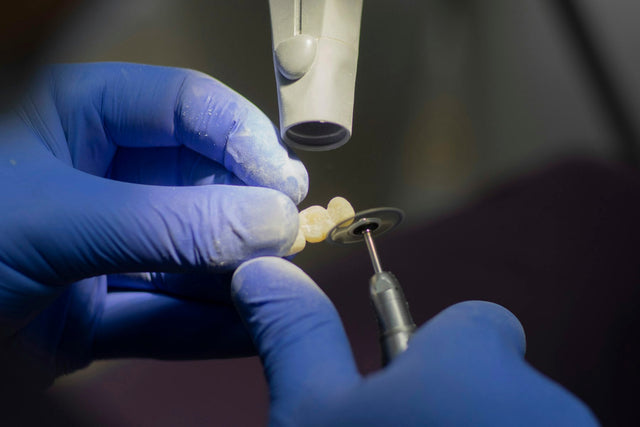
Industrially polymerized, cross-linked PMMA discs or blocks, milled from a digital design. Ivoclar's Telio CAD is cross-linked PMMA; VITA CAD-Temp adds about 14% inorganic microfiller by weight.
3D-printed provisional resins
Light-cured methacrylate resins printed layer by layer, then washed and post-cured on a validated printer and curing unit. This guide covers resins labeled for temporaries; for printed resins sold as definitive crowns, see 3D-Printed Permanent Crowns.
How Long Is Each Material Meant to Stay?
Manufacturer statements from current instructions for use (IFUs), checked October 1, 2026. They describe what each maker validated, not how long a provisional will last in a given mouth.
| Product | Type | Stated wearing time | Other limits |
|---|---|---|---|
| DMG Luxatemp Ultra | Chairside bis-acryl | Temporaries and long-term temporaries; DMG's FAQ says long-term Luxatemp temporaries can stay roughly 6 months | Not for permanent restorations |
| VITA CAD-Temp | Milled PMMA | Up to one year; contraindicated beyond one year | Up to two pontics; only terminal bridges recommended beyond six months |
| Ivoclar Telio CAD | Milled PMMA | Long-term temporaries; no maximum time stated | Up to two connected pontics; untreated bruxism and permanent restorations listed as limitations |
| BEGO VarseoSmile Temp | Printed | Lifetime limited to 12 months | Bridges up to 7 units; pontic no wider than one molar |
| SprintRay Digital Temp | Printed | Expected duration 29 days or less | Minimum thickness 0.6 mm |
| DETAX FREEPRINT temp | Printed | Less than 30 days, in its FDA-cleared indication | No clinical tests in the 510(k) summary |
Stated wearing time in current IFUs for two FDA-cleared printed temporary resins: SprintRay Digital Temp (29 days or less) and BEGO VarseoSmile Temp (12 months).
Telio CAD and VITA CAD-Temp both call for 1.5 mm occlusally, 0.8 mm circumferentially, and connectors of at least 12 mm², or 16 mm² for posterior bridges with two pontics. On untreated bruxism, see Restorations for Bruxers.
How Do They Compare in Strength and Fit?
All data in this section are from lab studies.
Single crowns: bis-acryl holds its own
After thermal cycling and 100,000 load cycles, bis-acryl crowns (Protemp 4) fractured at about 1,126 N, milled PMMA at 954 N and a printed resin at 1,004 N, with no significant difference among the three. A self-curing monomethacrylate acrylic was weaker, at 658 N.
Bridges: the digital options pull ahead
With 3-unit provisional bridges after cyclic loading, a printed resin (NextDent C&B MFH) fractured at 1,244 N and milled PMMA (Ceramill A-Temp) at 1,141 N, against 598 N for bis-acryl (Luxatemp Star). Marginal gaps were about 32 µm milled and 34 µm printed, against 92 µm for bis-acryl. In a long-span study, milled and printed resins also beat wire-reinforced bis-acryl for fracture resistance.
Printed bridges are not all equal
In a Regensburg study that simulated 5 years of chewing (1.2 million cycles), all chairside and milled 3-unit provisionals survived; none of the printed ones luted with Temp Bond NE did.
What the reviews conclude
A 2022 meta-analysis of interim resins found printed materials stronger in fracture and flexure but worse in color stability, water sorption and solubility than milled and conventional resins. A 2026 umbrella review of 14 reviews, including definitive printed composites, found printed resins generally weaker and less color stable than milled CAD/CAM materials. Brand matters: in one study, bis-acryl bars reached 118 MPa in flexure and a printed temporary resin 50 MPa.

How Do Color, Wear and Polish Compare?
Color
Milled PMMA is the most consistently color stable. After 180 days in staining solutions, CAD/CAM PMMA stained least and bis-acryl more. Telio CAD beat Protemp 4 in a 4-week staining test and a printed resin in a 2025 study. Between bis-acryl and printed resin, results flip: one study found bis-acryl changed more after coffee, another found printed resins changed more.
Wear
Short-term wear does not separate them. After 30,000 chewing cycles, about 1.5 months, volume loss did not differ significantly among bis-acryl, milled and two printed resins, and in patients printed and bis-acryl provisionals wore alike over 2 months.
Polish
Ivoclar's Telio CAD instructions call for polishing with light pressure at low speed. In a 2026 study of two printed resins and a self-curing acrylic, polishing alone beat stain and glaze or glaze alone for color stability, smoothness and microhardness after drinks and brushing.
Bis-Acryl vs. Milled PMMA vs. Printed Resin at a Glance
| Measure | Chairside bis-acryl | Milled PMMA | Printed resin |
|---|---|---|---|
| Single crown fracture after aging | 1,126 N | 954 N | 1,004 N |
| 3-unit bridge fracture load | 598 N | 1,141 N | 1,244 N |
| 3-unit bridge marginal gap | 92 µm | 32 µm | 34 µm |
| 5 years of simulated chewing, 3-unit | All survived (chairside material not named in the abstract) | All survived | None survived on Temp Bond NE |
| Color stability | Stains more than milled | Most stable | Varies; usually more staining than milled |
| Short-term wear | No significant difference after 30,000 chewing cycles | ||
What Does the Clinical Evidence Show?
- Printed vs. bis-acryl, US crossover trial: each patient wore a printed (Formlabs Temporary CB) and a bis-acryl (Integrity) provisional on the same tooth. After at least 2 months, printed crowns had better luster and periodontal response but more fractures and loss of retention; the authors advise care with occlusion and cementation for longer periods.
- Milled PMMA bridges: 45 VITA CAD-Temp 3- and 4-unit bridges in 27 patients with compromised dentitions. Designs with an abutment at each end had estimated 16-month survival of 90.4% (88.3% complication-free); 3 of 8 cantilevers were removed within 8 months.
- Implant provisionals: in a randomized trial of 42 anterior implant provisional crowns in 33 patients, printed crowns had more catastrophic fractures than conventional PMMA, with shorter operating time and similar patient satisfaction.
When Is a Lab-Made Long-Term Provisional Worth It?
Long spans and more than one pontic
Here chairside material falls furthest behind in the lab data. Plan connectors to the IFU minimum and avoid cantilevers in anything meant to last months.
Full-mouth rehabilitation and bite changes
When provisionals carry a new occlusal scheme or vertical dimension for months, choose a material labeled for the whole phase and expect adjustments. Telio CAD's instructions describe relining and repair with a bonding agent and composite.
Implant healing
Healing takes months, and the implant trial above favored conventional PMMA for fracture. For full-arch interim prostheses, see Full-Arch Implant Prosthesis: Zirconia vs. PMMA vs. Metal-Acrylic.

Esthetic trials
If the patient judges shade and shape over weeks, milled PMMA's color stability is the strongest argument. For shade records, see Shade Matching for the Lab.
When bis-acryl is enough
Single crowns and short bridges worn for a few weeks: aged bis-acryl crowns matched milled and printed ones for fracture load.

How Should You Cement and Remove Long-Term Provisionals?
If the final restoration will be resin-cemented, use a eugenol-free temporary cement: DMG notes that eugenol may prevent polymerization of resin-based luting cements, and VITA requires eugenol-free cement in that case. A meta-analysis of 14 lab studies found that temporary cementation lowered dentin bond strength unless the dentin had been sealed, and that aluminum oxide abrasion restored bond strength better than hand instruments alone.
Plan recalls. Ivoclar says to check temporarily cemented long-term provisionals regularly and recement as needed, and warns that adhesively cemented ones may be hard to remove; VITA requires recalls beyond four weeks of wear. For the definitive seat, see How to Cement Zirconia and Bond E.max Crowns.
Provisionals at Elegant Dental Laboratory
- We make provisionals alongside zirconia, IPS e.max, PFM and implant restorations, every case in house in Brooklyn, with more than 35 technicians.
- Digital scans are reviewed before production; we accept STL and PLY files from all major intraoral scanners (submit a digital case).
- Turnaround from 5 business days on most restorative cases; rush is decided case by case.
- Free pickup and delivery by our own drivers every business day during lab hours in all five New York City boroughs and 13 northern New Jersey counties; elsewhere, print a prepaid UPS label. Questions: 877-335-5221 or send a case.
FAQ
How long can a bis-acryl provisional stay in?
DMG says long-term Luxatemp temporaries can stay roughly 6 months. For longer phases or multi-unit spans, milled provisionals have stronger data.
Is milled PMMA stronger than bis-acryl?
For aged single crowns, not significantly in one study. For 3-unit bridges, milled PMMA withstood about twice the load in another.
Are 3D-printed provisional resins FDA cleared?
Many are, as Class II temporary crown and bridge resins under 21 CFR 872.3770. Labeled wearing times differ, from 29 days or less to 12 months.
Which provisional material stains least?
Milled PMMA, in most lab and in situ studies. Bis-acryl and printed resins usually stain more.
Which temporary cement should I use under a long-term provisional?
A eugenol-free one if the final will be resin-cemented, with regular recalls to recement if needed.
Can a printed permanent crown resin serve as a provisional?
A university clinic printed 98 temporary crowns in Formlabs Permanent Crown Resin and reported 98% survival over an average of 256 days.
Sources (30)
- Elashkar M, et al. Evaluation of the marginal fit and fracture resistance of interim restorations fabricated using different techniques: an in vitro study. BMC Oral Health. 2025;25(1):354. doi:10.1186/s12903-025-05679-y
- Sauter TB, Hahnel S, Rosentritt M, Lang R. Fracture resistance and survival rates of chairside, milled, and 3D-printed provisional three-unit FDPs with two cements before and after masticatory simulation. Clin Oral Investig. 2026;30(8):325. doi:10.1007/s00784-026-07011-6
- Reeponmaha T, Angwaravong O, Angwarawong T. Comparison of fracture strength after thermo-mechanical aging between provisional crowns made with CAD/CAM and conventional method. J Adv Prosthodont. 2020;12(4):218-224. doi:10.4047/jap.2020.12.4.218
- Herdocia-Lluberes CS, et al. Fracture resistance of analog and CAD-CAM long-span fixed provisional restorations: An in vitro experimental study. J Prosthodont. 2025, online ahead of print. doi:10.1111/jopr.14021
- Jain S, et al. Physical and Mechanical Properties of 3D-Printed Provisional Crowns and Fixed Dental Prosthesis Resins Compared to CAD/CAM Milled and Conventional Provisional Resins: A Systematic Review and Meta-Analysis. Polymers (Basel). 2022;14(13):2691. doi:10.3390/polym14132691
- Dascanio R, Kury M, Özcan M, Cavalli V. How durable are 3D-printed dental resin-based composites? An umbrella review. J Dent. 2026;168:106626. doi:10.1016/j.jdent.2026.106626
- Ribeiro AKC, et al. Flexural strength, surface roughness, micro-CT analysis, and microbiological adhesion of a 3D-printed temporary crown material. Clin Oral Investig. 2023;27(5):2207-2220. doi:10.1007/s00784-023-04941-3
- Bitencourt SB, et al. Long-term stainability of interim prosthetic materials in acidic/staining solutions. J Esthet Restor Dent. 2020;32(1):73-80. doi:10.1111/jerd.12544
- Almohareb T, et al. Influence of experimental staining on the color stability of indirect computer-aided design/computer-aided manufacturing dental provisional materials. Eur J Dent. 2018;12(2):269-274. doi:10.4103/ejd.ejd_1_18
- Rinaldi T, et al. Colour Stability and Optical Properties of Provisional Crowns Fabricated With Milling, 3D Printing, and Direct Technique. Int Dent J. 2025;75(6):103932. doi:10.1016/j.identj.2025.103932
- Rodrigues PRB, et al. Impact of Extrinsic Staining on the Physical Properties of Provisional Resins Fabricated by Digital and Conventional Methods: An In Situ Study. Int J Prosthodont. 2026;39(2):227-234. doi:10.11607/ijp.9263
- Mesquita JJ, et al. Color stainability, microhardness, sorption, and solubility of 3D printed interim crowns. J Prosthet Dent. 2026;136(1):e428-e434. doi:10.1016/j.prosdent.2026.02.033
- Çiçek Y, Küçük C. Wear of interim resin materials manufactured by 3D printing and CAD/CAM milling following chewing simulation. BMC Oral Health. 2025;25(1):1679. doi:10.1186/s12903-025-07105-9
- Moss OB, et al. 3D-Printed Versus Conventional Dental Provisional Resins: A Comparative Study. Medicina (Kaunas). 2026;62(2):382. doi:10.3390/medicina62020382
- Hardison TW, et al. Clinical Performance of 3D-Printed Provisional Dental Crowns. Mil Med. 2026;191(3-4):e601-e607. doi:10.1093/milmed/usaf435
- Huettig F, et al. First clinical experiences with CAD/CAM-fabricated PMMA-based fixed dental prostheses as long-term temporaries. Clin Oral Investig. 2016;20(1):161-168. doi:10.1007/s00784-015-1475-7
- de Souza FA, et al. 3D-printed and conventional provisional single crown fabrication on anterior implants: A randomized clinical trial. Dent Mater. 2024;40(2):340-347. doi:10.1016/j.dental.2023.12.004
- Del Hougne M, et al. A retrospective cohort study on 3D printed temporary crowns. Sci Rep. 2024;14(1):17295. doi:10.1038/s41598-024-68354-2
- Ding J, et al. Effect of temporary cements and their removal methods on the bond strength of indirect restoration: a systematic review and meta-analysis. Clin Oral Investig. 2023;27(1):15-30. doi:10.1007/s00784-022-04790-6
- US Code of Federal Regulations. 21 CFR 872.3770, Temporary crown and bridge resin. eCFR
- US Food and Drug Administration. openFDA 510(k) records, product code EBG (crown and bridge, temporary, resin), accessed October 1, 2026. api.fda.gov
- US Food and Drug Administration. 510(k) summary K200273, FREEPRINT temp (DETAX), October 27, 2020. accessdata.fda.gov
- US Food and Drug Administration. 510(k) summary K242559, Digital Temp (SprintRay), November 26, 2024. accessdata.fda.gov
- SprintRay. Digital Temp Instructions for Use, IFU-026 Revision 3, effective July 29, 2026. PDF
- BEGO. VarseoSmile Temp Instructions for Use (USA), REF 19577US/02, 2022-05-06, from the BEGO eIFU database. ifu.bego.com
- VITA Zahnfabrik. VITA CAD-Temp Instructions for Use, 1647E_1224_V09, date of issue 2024-02. PDF
- Ivoclar. Telio CAD Instructions for Use, Rev. 0, 2025-07-16 (eIFU). ivoclar.com
- DMG. Luxatemp Ultra Instructions for Use (US), 092961/2022-09. PDF
- DMG America. Temporary Crown and Bridge FAQ, accessed October 1, 2026. dmg-connect.com
- Dentsply Sirona. Integrity Multi•Cure product page (US), accessed October 1, 2026. dentsplysirona.com
Reviewed by Gary Fingerman, founder and CEO of Elegant Dental Laboratory, Brooklyn, New York (founded 2007). Last reviewed: October 1, 2026. Study values are from published research; wearing times and handling rules are manufacturer statements, so always follow the current instructions for use of the material you choose.