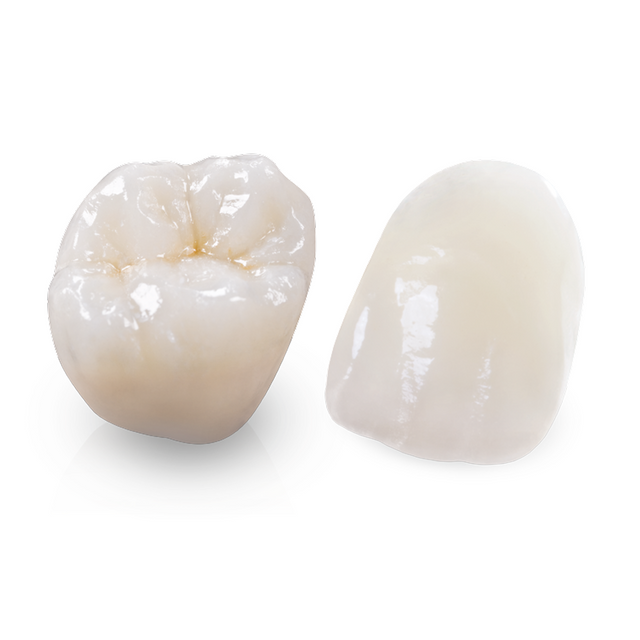
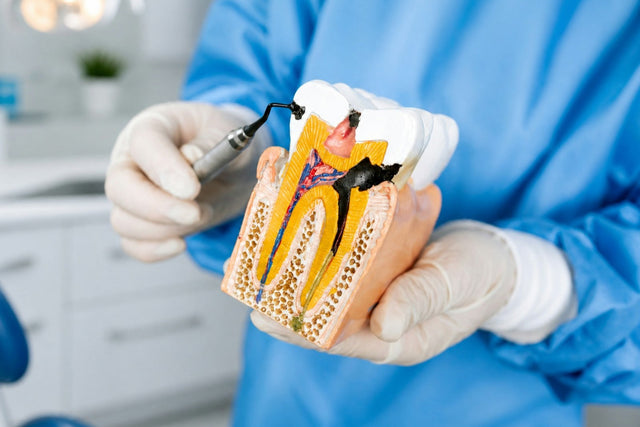
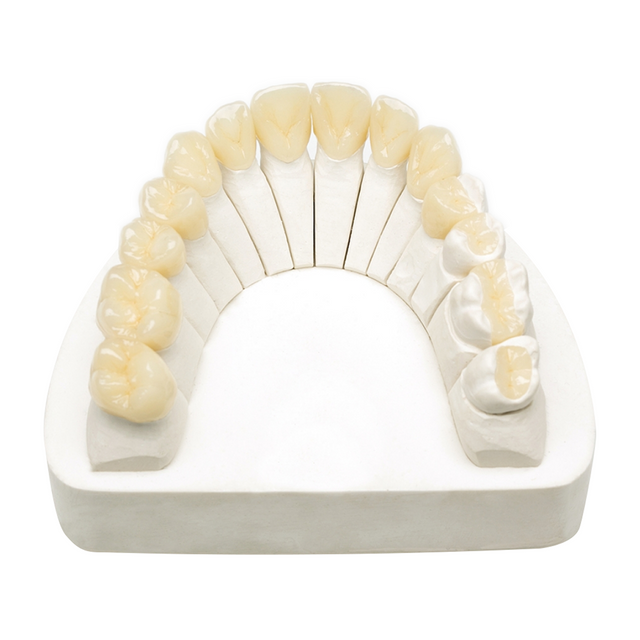
Chairside printers now come with resins labeled for permanent crowns, and a one-visit crown is an easy sell. The question dentists bring us is practical: can a printed resin crown replace the zirconia or e.max crown you would otherwise send out, and for which patients?
The answer depends on the resin, its current instructions and evidence that is still young. Below: FDA status, lab and clinical data against zirconia and lithium disilicate, and when to print or send.
Key Takeaways
- FDA has cleared several printable resins for definitive crowns through 510(k), including VarseoSmile Crown plus (K201668, 2020); its summary, like Crowntec's and TriniQ's, includes no clinical data.
- A 2026 umbrella review of 14 systematic reviews found printed resins generally weaker, less color-stable and more water-absorbent than milled CAD/CAM materials.
- In a 2026 prospective study, 30 printed posterior crowns had 93% survival at about 2 years; bruxers were excluded.
- A 2026 meta-analysis of 64 studies estimated 5-year survival of 98.5% for monolithic lithium disilicate and 96.8% for monolithic zirconia crowns.
- Fit is a strength, but orientation matters: intaglio trueness ranged from 37 µm at 0° to 113 µm at 90° in one study.
- Minimum thickness runs from 0.6 to 1.5 mm by resin; two current instructions for use rule out or advise against bruxism.
Quick Answer
Printed "permanent" crowns are FDA-cleared filled resins, not ceramics. In lab tests they fit well but are weaker, stain more and absorb more water than milled materials, and clinical data on natural teeth stop at about 2 years in small groups. They suit long-term provisionals and selected single crowns in low-load, non-bruxing patients. For bruxers, bridges, esthetic anterior work and restorations meant to last many years, zirconia and lithium disilicate have the evidence.
What Are 3D-Printed Permanent Crown Resins?
They are light-cured methacrylate resins filled with glass or ceramic particles, printed layer by layer and post-cured. BEGO and Saremco list 30 to 50% inorganic filler by mass for VarseoSmile Crown plus and Crowntec; SprintRay lists more than 50% by weight for Ceramic Crown. Despite the names, they are polymers, closer to a CAD/CAM composite block than to a ceramic.
How FDA cleared them
They reach the US market through 510(k) as Class II devices, showing equivalence to earlier resins with bench tests such as ISO 4049. The summaries for VarseoSmile Crown plus, Crowntec, Bridgetec and TriniQ state that no clinical data were included. Clearance says the material met those standards, not how long a crown lasts.
What current instructions allow (September 2026; revisions in Sources)
| Resin | FDA clearance | Definitive uses | Minimum thickness | Notable limits |
|---|---|---|---|---|
| SprintRay Ceramic Crown | 2022, as "Digital Crown" | Single crowns, partial crowns, veneers | 0.6 mm in the design file | No bridges listed |
| BEGO VarseoSmile Crown plus | 2020 | Single crowns, inlays, onlays, veneers | 1.0 mm; veneers 0.5 mm | Crown height up to 1.6 times the bonding surface |
| Formlabs Permanent Crown | Same clearance as VarseoSmile Crown plus | Single crowns, inlays, onlays, veneers | 1.0 mm; veneers 0.5 mm | Not for titanium adhesive bases |
| BEGO VarseoSmile TriniQ | 2023 | Single units; bridges up to 7 units, one pontic between abutments | 0.7 mm single units; 1.0 mm bridges, connectors 14 to 16 mm² | Glass ionomer cement not suitable |
| Saremco Crowntec | 2022 | Single crowns, inlays, onlays, veneers; bridges only as provisionals | Posterior crown 1.5 mm occlusal, 1.0 mm at the margin | Contraindicated: bruxism; cantilever, Maryland and inlay bridges; more than one pontic |
| Rodin Titan | 2024 | Single units; multi-unit only as provisionals | 1.5 mm posterior; 1.0 mm anterior buccal | No cantilever or Maryland bridges; not recommended for bruxism |
Saremco's Bridgetec (K232050) is cleared for permanent 3-unit bridges. Formlabs Premium Teeth is cleared as a temporary crown and bridge resin (K240538), and Formlabs' product page says it is not indicated for permanent restorations. All recommend resin-based cements; SprintRay's protocol specifies air abrasion, a universal adhesive and a dual-cure resin cement.
For provisional materials compared, see Provisional Crowns and Bridges: Bis-Acryl vs. Milled PMMA vs. 3D-Printed Resin.

How Do Printed Resins Compare With Zirconia and E.max in the Lab?
All data in this section are in vitro.
Strength
Makers' specifications show the gap: VarseoSmile Crown plus at 100 MPa flexural strength or more, Crowntec at 120 MPa or more, TriniQ at 120 MPa. Ivoclar specifies IPS e.max CAD at 360 MPa or more in biaxial testing (typical mean 530 MPa) and IPS e.max ZirCAD Prime at 900 MPa or more (typical 1,200 MPa). Test methods differ, so read these as orders of magnitude.
Fracture load and aging
A 2026 meta-analysis of 14 studies found milled resin crowns more fracture resistant than printed ones, most clearly after aging. Aged Crowntec molar crowns 0.5 mm thick occlusally, well under Saremco's minimum, failed below reported chewing loads, while 1.0 mm and thicker exceeded them; e.max CAD was stronger at every thickness. Yet bonded 1.2 mm SprintRay Ceramic Crown onlays survived 2 million fatigue cycles and failed at 2,574 N, not significantly different from e.max CAD at 2,396 N.
Wear, water and color
Resin is gentler on opposing enamel. Zirconia and e.max CAD wore opposing teeth more than a printed nanohybrid resin but wore less themselves; in the study of SprintRay's resin, e.max wore more on both counts. Printed resins also absorb more water and lose more color with aging; a 2026 meta-analysis of 37 studies found a mean color change 1.40 ΔE units larger than for milled resins.
What Does the Clinical Evidence Show?
It is short and small: the umbrella review describes 6 to 24 months of follow-up and calls long-term durability uncertain.
- Crowns on natural teeth: 30 patients, probable bruxers excluded, each received one bonded posterior VarseoSmile Crown plus crown. At about 2 years, survival was 93% and success 87%: two crowns failed irreparably, two had minor cusp fractures that were polished, two debonded and were recemented. There was no control group.
- Overlays and endocrowns: 33 restorations in Formlabs' permanent ceramic-filled resin were all acceptable at 2 years, but the share scoring best for marginal discoloration fell from 100% to 69.7%.
- Noninvasive restorations for tooth wear: one group reported 84.4% survival for 171 restorations at 12 months; in its 24-month report on 352 restorations, 35% had worn more than 0.5 mm, and the authors judged the material suitable only for interim use.
- Implant restorations: 278 printed hybrid composite restorations had 97.8% survival at 3 years in a retrospective study.
Share of 190 printed restorations with a color change above ΔE 6.8, the worst rating, after 2 years in patients; the authors recommend about 6 months of wear (Doumit et al., 2024).
Ceramics have far deeper evidence: the 2026 survival meta-analysis pooled 64 studies with at least 3 years of mean follow-up, including 8,051 all-ceramic crowns.
Do Printed Crowns Fit as Well as Milled Ones?
Fit is where printing does well. A 2025 meta-analysis of 57 studies found no significant difference in marginal fit between printed and milled restorations, and milled acrylic resin restorations had a 39 µm larger occlusal gap. The 2026 crown meta-analysis found smaller marginal gaps for printed crowns measured directly on teeth, with low to very low certainty.
Print orientation
With Formlabs Permanent Crown on a Form 3B+, intaglio trueness was 37 µm at 0° and 113 µm at 90°. In a 2026 micro-CT study the effect depended on the resin: Crowntec exceeded a 120 µm marginal gap at 90°, VarseoSmile Crown plus at 0°. Another study found 45° most accurate for crowns on an LCD printer. Use the orientation in your resin's instructions.
Washing and post-curing
Formlabs requires two 20-minute cures at 60 °C on the original Form Cure and warns that deviations may affect fit and biocompatibility. BEGO caps ethanol cleaning at 5 minutes, Rodin total IPA exposure at 10. In lab studies, Crowntec crowns gained fracture resistance with post-curing up to 30 minutes, and curing in nitrogen cut wear to the level of a milled hybrid ceramic.
What Does Chairside Printing Involve?
- Design: an STL file from CAD software or a design service, increasingly AI-assisted (see AI Crown Design in Dental Labs).
- Print: on a validated printer; BEGO and Saremco specify 50 µm layers.
- Wash and dry: in alcohol, within the stated time limit.
- Remove supports and blast: BEGO and Formlabs specify 50 µm glass beads at up to 1.5 bar.
- Post-cure: in a validated unit, for example 60 minutes at 60 °C in SprintRay's ProCure.
- Finish: polish, or characterize with light-cured stains and glaze; Rodin warns against furnace-fired systems.
- Bond: per the resin's luting protocol.
Each resin is validated with specific printers and cure units; BEGO's US instructions warn that unapproved changes can leave the device "out of specification and not covered under the FDA clearance." Cost data are thin: a 2026 scoping review of 9 studies found lower material cost, lower initial investment and less waste for printing, but faster production and higher accuracy for milled single units.
Considering chairside milling instead? See Chairside Milling vs. Lab-Made Crowns: Fit, Strength, Time and When Each Makes Sense.
Printed Resin vs. Zirconia vs. Lithium Disilicate
| Printed resin crown | Milled zirconia | Lithium disilicate | |
|---|---|---|---|
| Indications (current IFUs) | Single crowns, inlays, onlays, veneers; permanent bridges only with some resins | Crowns and bridges; IPS e.max ZirCAD Prime up to multi-unit with 2 pontics | Veneers, inlays, onlays, crowns, 3-unit bridges to the second premolar (IPS e.max CAD) |
| Minimum crown thickness | 0.6 to 1.5 mm, by resin | 0.8 mm anterior, 1.0 mm posterior (ZirCAD Prime, MT) | 1.5 mm occlusal; 1.0 mm only if bonded |
| Flexural strength (maker spec) | 100 to 120 MPa or more | 700 to 900 MPa or more | 360 MPa or more (biaxial) |
| Clinical evidence | About 2 years; cohorts of about 30 crowns | 5-year survival 96.8% (monolithic) | 5-year survival 98.5% (monolithic) |
| Bruxism | Contraindicated or not recommended by Saremco and Rodin | Untreated bruxism is a limitation of use; splint after | Same limitation; splint after |
| When to use | Long-term provisionals; selected single units in low-load mouths | Posterior crowns, bridges, bruxers, limited space | Esthetic anterior and premolar crowns, bonded partial coverage |
Zirconia grades differ in strength and translucency (see Types of Zirconia Explained); for choosing between the ceramics, see Zirconia vs. E.max.

When Does Printing Make Sense, and When Should You Send It to the Lab?
- Long-term provisionals: printing's strongest case. Crowntec, TriniQ and Rodin Titan are labeled for temporary bridges. Lab-made provisionals are another route.
- A single posterior crown in a low-load mouth: reasonable within the IFU: full thickness, adhesive cementation, no parafunction, and a patient who knows the data stop at about 2 years.
- Bruxers: send it. Two IFUs rule them out or advise against them, and wear data are unfavorable; monolithic zirconia plus a night guard is the usual pairing (see Restorations for Bruxers).
- Bridges: send it. Few resins are cleared for permanent bridges, and the umbrella review's clinical data covered inlays, onlays, overlays, crowns and veneers, not bridges.
- Esthetic anterior cases: send it. Discoloration was reported at 2 years in the crown, overlay and noninvasive studies above.
- Implant crowns: check the IFU; Formlabs Permanent Crown is not for titanium bases.

Crowns and Provisionals at Elegant Dental Laboratory
- Every case is made in house in Brooklyn by more than 35 technicians; digital scans are reviewed before production.
- Zirconia (solid, 9-layer, solid with buccal porcelain, and layered), IPS e.max, PFM, provisionals and 3D-printed permanent crowns. We do not supply design-only files for in-office printing.
- Turnaround from 5 business days on most restorative cases, rush decided case by case, and up to a 7-year warranty on final restorations (policies and warranties).
- Submit a digital case or send a case: our own drivers pick up free every business day in the five NYC boroughs and 13 northern New Jersey counties, and UPS labels work anywhere. Call 877-335-5221.
Related Guides
- PFM vs. Zirconia Crowns in 2026: When Metal-Ceramic Still Makes Sense
- Crown Prep Guide: Reduction, Margins and Taper for Zirconia, E.max and PFM
- E.max Press vs. E.max CAD: Which Lithium Disilicate Should You Prescribe?
FAQ
Are 3D-printed permanent crowns FDA approved?
Cleared, not approved: several resins went through 510(k) as Class II devices; the Crown plus, Crowntec and TriniQ summaries include no clinical data.
How long do printed permanent crowns last?
Unknown beyond about 2 years; the prospective crown study reported 93% survival in 30 patients without bruxism.
Are printed crowns as strong as e.max?
Not as materials: about 100 to 120 MPa against 360 MPa or more for e.max CAD. Bonded onlays performed similarly in one fatigue study; e.max was stronger at every thickness in another.
Can I print a crown for a bruxer?
Saremco contraindicates it and Rodin advises against it; monolithic zirconia with a night guard is safer.
Can printed resins be used for bridges?
Only a few, such as TriniQ and Bridgetec, are cleared for permanent bridges; the others are for single units, some with bridges as provisionals.
Sources (38)
- US Food and Drug Administration. 510(k) summary K201668, VarseoSmile Crown plus (BEGO), June 23, 2020. accessdata.fda.gov
- US Food and Drug Administration. 510(k) summary K222623, Digital Crown (SprintRay), December 14, 2022. accessdata.fda.gov
- US Food and Drug Administration. 510(k) summary K213343, saremco print CROWNTEC, January 21, 2022. accessdata.fda.gov
- US Food and Drug Administration. 510(k) summary K232050, saremco print BRIDGETEC, November 14, 2023. accessdata.fda.gov
- US Food and Drug Administration. 510(k) summary K233596, VarseoSmile TriniQ (BEGO), November 9, 2023. accessdata.fda.gov
- US Food and Drug Administration. 510(k) summary K240688, RODIN Titan 3D Resin, June 20, 2024. accessdata.fda.gov
- US Food and Drug Administration. 510(k) summary K240538, Premium Teeth Resin (Formlabs), July 19, 2024. accessdata.fda.gov
- US Food and Drug Administration, National Library of Medicine. AccessGUDID device records: SprintRay Ceramic Crown A2, premarket submission K222623 (record); BEGO Permanent Crown A2, model FLPCA201US, K201668 (record).
- SprintRay. Ceramic Crown Resin Instructions for Use, IFU-016_12, effective July 29, 2026. PDF
- SprintRay. Ceramic Crown Cementation Protocol featuring Variolink Esthetic DC (20240627). PDF
- BEGO. VarseoSmile Crown plus Instructions for Use (USA), REF 20740US/04, 2022-03-30, from the BEGO eIFU database. ifu.bego.com
- BEGO. VarseoSmile TriniQ Instructions for Use (en-us), 20681-06, 2025-05-27, from the BEGO eIFU database. ifu.bego.com
- Formlabs. Permanent Crown Resin Instructions for Use (US), REF 20811/02 Rev 06, prepared January 14, 2025. PDF
- Formlabs. Premium Teeth Resin product page (US), accessed September 28, 2026. dental.formlabs.com
- SAREMCO Dental AG. saremco print CROWNTEC Instruction for Use, US version, D600248, edited 02-2026. PDF
- Rodin. Rodin Titan Instructions for Use, Revision 090426. PDF
- Ivoclar. IPS e.max CAD Instructions for Use, Rev. 5, 2026-02-11 (eIFU). ivoclar.com
- Ivoclar. IPS e.max ZirCAD (labside) Instructions for Use, Rev. 3, 2026-02-11 (eIFU). ivoclar.com
- Dascanio R, et al. How durable are 3D-printed dental resin-based composites? An umbrella review. J Dent. 2026;168:106626. doi:10.1016/j.jdent.2026.106626
- Alawawda O, et al. Fracture Resistance and Marginal Adaptation of 3D-Printed Versus Milled Resin-Based Permanent Crowns: A Systematic Review and Meta-Analysis. J Esthet Restor Dent. 2026, online ahead of print. doi:10.1111/jerd.70248
- Mosaddad SA, et al. Do color stability and translucency differ between 3D printed and milled resin-based fixed dental restorations? A systematic review and meta-analysis. J Prosthet Dent. 2026;136(1):30-39. doi:10.1016/j.prosdent.2026.02.015
- Tartuk BK, et al. Fracture Resistance of CAD/CAM Lithium Disilicate and 3D-Printed Resin Crowns with Varying Occlusal Thickness: An In Vitro Study. Materials (Basel). 2026;19(6):1180. doi:10.3390/ma19061180
- Bora PV, et al. Enamel wear and fatigue resistance of 3D printed resin compared with lithium disilicate. J Prosthet Dent. 2025;133(2):523.e1-523.e9. doi:10.1016/j.prosdent.2024.10.024
- Ghabchi B, et al. Wear behavior of CAD-CAM zirconia, ceramic, and 3D printed nano-hybrid resin crowns for the restoration of primary and permanent molars: An in vitro study. J Prosthet Dent. 2025;134(1):177.e1-177.e8. doi:10.1016/j.prosdent.2025.02.040
- Del Piñal Pellón M, et al. Performance of posterior 3D printed resin-matrix ceramic crowns fabricated in a fully digital workflow: a two-year prospective clinical study. Clin Oral Investig. 2026;30(5):185. doi:10.1007/s00784-026-06883-y
- Sonkaya E, Bek Kürklü GZ. Additively Manufactured Definitive Crown Resins on Premolar and Molar Teeth: 2-Year Results of a Prospective Clinical Study. Int J Prosthodont. 2025;38(3):279-289. doi:10.11607/ijp.9200
- Prause E, et al. Survival and complications of 3D-printed, noninvasive restorations for prosthetic rehabilitations: a 12-month preliminary observational study. Int J Comput Dent. 2024;27(4):379-388. doi:10.3290/j.ijcd.b4451424
- Doumit M, et al. Wear behavior of 3D printed, minimally invasive restorations: Clinical data after 24 months in function. J Prosthet Dent. 2025;134(3):662-669. doi:10.1016/j.prosdent.2025.03.014
- Doumit M, et al. The colour stability of 3D-printed, non-invasive restorations after 24 months in vivo: esthetically pleasing or not? J Dent. 2024;150:105391. doi:10.1016/j.jdent.2024.105391
- Mangano FG, et al. Three-year clinical outcomes of additively manufactured hybrid composite implant-supported restorations fabricated through tilting stereolithography: a retrospective clinical study. J Dent. 2026;173:106837. doi:10.1016/j.jdent.2026.106837
- Pjetursson BE, et al. A Systematic Review and Meta-analysis Evaluating the Survival, Failure, and Complication Rates of Metal-Ceramic, Veneered, and Monolithic All-Ceramic Tooth-Supported Single Crowns, Part 1. Int J Prosthodont. 2026;39(3):308-324. doi:10.11607/ijp.9633
- Németh A, et al. Comparison of fit and trueness of single-unit and short-span fixed dental restorations fabricated by additive and subtractive manufacturing: A systematic review and meta-analysis. J Dent. 2025;153:105527. doi:10.1016/j.jdent.2024.105527
- Revilla-León M, et al. Manufacturing accuracy of the intaglio surface of definitive resin-ceramic crowns fabricated at different print orientations by using a stereolithography printer. J Prosthet Dent. 2025;133(2):505-511. doi:10.1016/j.prosdent.2023.04.012
- Sarı DS, Sevmez H. Effect of Material Type and Printing Orientation on the Marginal and Internal Fit of Additively Manufactured Definitive Resin Crowns: A Micro-Computed Tomography Study. J Dent. 2026, online ahead of print:107065. doi:10.1016/j.jdent.2026.107065
- Atasoy S, et al. Effect of the build angle on the accuracy of 3D-printed definitive composite resin crowns, onlays, and laminate veneers: An in vitro study. J Dent. 2026;175:106937. doi:10.1016/j.jdent.2026.106937
- Korkmaz YN, et al. Effects of Different Post Curing Times and Methods on Fracture Resistance and Flexural Strength of 3D-Printed Permanent Crown Resin. Int J Prosthodont. 2026, online ahead of print. doi:10.11607/ijp.9575
- Soydan M, Manav TY. Effect of postpolymerization on the wear behavior of additively manufactured definitive crown resins. J Prosthet Dent. 2026, online ahead of print. doi:10.1016/j.prosdent.2026.07.007
- Packaeser MG, et al. Economic aspects of 3D printing in restorative dentistry: a scoping review. Minerva Dent Oral Sci. 2026;75(3):200-213. doi:10.23736/S2724-6329.25.05258-1
Reviewed by Gary Fingerman, founder and CEO of Elegant Dental Laboratory, Brooklyn, New York (founded 2007). Last reviewed: September 28, 2026. Product details are from the manufacturers' current instructions for use and FDA records as of that date; instructions change, so check the current version for the resin you use.