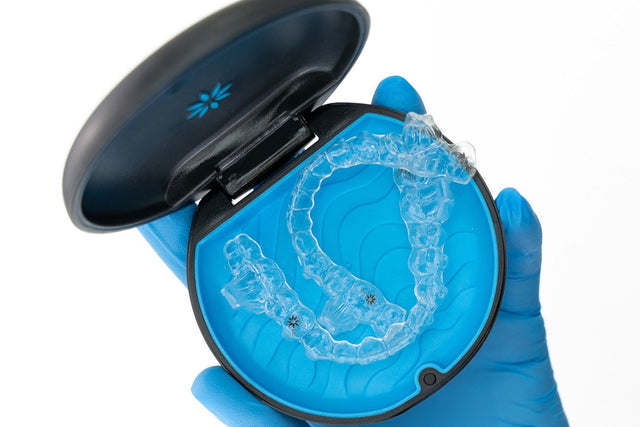
An immediate denture is the one removable case where nobody sees the ridge before the denture is made. The impression still has teeth in it, and the denture has to seat over fresh sockets the same day. Then the ridge keeps changing under it for months.
Many surgery-day surprises start earlier, in the records and the cast surgery. Below: planning, records, digital options, ridge shrinkage, and the evidence on soft liners and the definitive reline.
Key Takeaways
- A systematic review of 20 studies found the ridge lost 29% to 63% of its width and 11% to 22% of its height in about 6 months, fastest in the first 3 to 6 months.
- Under maxillary immediate dentures in a randomized trial, the buccal crest lost 1.2 mm of height by 3 months and 2.1 mm by 1 year without socket grafting; with a xenograft, 0.7 mm at 1 year.
- In a 74-patient trial, keeping two lower canine roots under an immediate overdenture halved first-year bone loss in the canine region: 0.9 mm against 1.8 mm.
- One 2025 case series trimmed the stone 2 mm buccally and 1 mm lingually, guided by a panoramic radiograph: one case, not a rule.
- Published protocols keep the denture in for the first 24 hours, some for 48, before the patient removes it.
- The definitive reline often comes 6 to 9 months after extraction (Foundation for Oral Rehabilitation), but neither the ACP nor a 2026 Canadian review found an evidence-based reline schedule.
Quick Answer
An immediate denture is built before the last teeth come out, so the lab needs a full-arch impression or scan with the teeth present, a verified bite, tooth selection, the teeth to extract and how much ridge to trim. It is seated right after extraction and stays in until a next-day check. Plan soft liners through the fastest shrinkage, in the first 3 to 6 months, then a definitive reline or a new denture once the ridge settles.
Conventional or Interim: Which Immediate Denture Are You Planning?
The Glossary of Prosthodontic Terms (10th edition, 2023) defines an immediate denture by timing alone: made to be placed right after the natural teeth are removed. How long it serves is a planning decision. The Glossary's interim prosthesis, used for a limited time and then replaced by a definitive one, describes one option.
| Conventional immediate denture | Interim immediate denture | |
|---|---|---|
| Intended service | The long-term denture, relined after healing | A limited period, then a definitive denture or implant prosthesis |
| After healing | Reline when fit is lost; in one published case the patient needed none in 10 years, which the authors call uncommon | Replaced; a digital design can be reused |
A 2025 systematic review of 19 studies describes the common sequence: posterior teeth first, the rest after 2 to 3 months of healing (Sikri et al.).
What Records Does the Lab Need Before Extraction?
Impressions or scans with the teeth present
The working impression covers the whole denture-bearing area and the remaining teeth; Yeung et al. call an accurate record of the teeth essential for trimming the model and copying them. With very mobile teeth, Farrag et al. blocked the interdental undercuts with utility wax and border molded with green stick compound first. An intraoral scan removes the risk of pulling a tooth during the impression (Oh et al., 2019).
Bite and vertical dimension
Record bases, wax rims, a jaw relation record and a facebow follow standard denture steps (Yeung et al.). Record the vertical dimension carefully: as the ridge resorbs, immediate dentures settle and vertical dimension and overjet decrease (Tallgren et al., 1980).
Tooth selection and try-in
An immediate denture can copy the shade, shape and position of the natural teeth (Yeung et al.). The catch, notes the Foundation for Oral Rehabilitation, is that the remaining teeth prevent a full try-in, so the result is less predictable. Try in what the teeth allow.
How Much Ridge Should Be Trimmed on the Cast?
Cast surgery removes the stone teeth and shapes the ridge to approximate its form right after extraction. Over-trimming is the risk: the denture then presses on that area, which Yeung et al. check closely at the 24-hour visit. Where an undercut must be managed, they want the dentist, not the technician, to trim the cast, because trimming it helps plan the surgery.
Match the depth to the planned surgery; a 1976 comparison with labial plate and intraseptal alveoloplasty found simple extraction preserves the most ridge (Michael and Barsoum). In one case of Farrag et al.'s 2025 series, the casts were trimmed 2 mm buccally and 1 mm lingually, using the panoramic radiograph to estimate bone level; a clear thermoformed surgical guide made on them showed, by blanching, where bone needed reduction. If you graft the sockets, say so: grafting changed resorption in the trial below.
| Step | What the dentist sends | Typical lab steps |
|---|---|---|
| Preliminary records | Impressions or scans of both arches, photos, the plan | Study models; custom trays if requested |
| Final impression | Border-molded impression with the teeth present, or scans plus border molding | Master cast, stone or printed |
| Jaw relation | Bite on record bases, vertical dimension, facebow if used | Articulator mounting |
| Teeth and try-in | Shade, mold, copy-or-change notes; try-in approval | Wax setup for try-in |
| Cast surgery | Teeth to extract; trimming depth or radiograph; grafting plans | Stone teeth removed, ridge contoured, teeth set; surgical guide if requested |

Can Immediate Dentures Be Made Digitally?
Yes, though the evidence is clinical reports and technique papers; we found no randomized trial against conventional immediate dentures.
- Hybrid, two visits: scans and bite at visit one, printed trial bases, teeth set and processed conventionally, then placement with a reline (Oh et al., 2019).
- Fully digital: teeth removed virtually, denture designed and milled with no conventional impression or stone cast (Fang et al., 2018).
- Guided surgery: ridge recontoured in CAD, then a printed alveoloplasty guide and verification stent (Badr et al., 2025).
- Analog borders: scans miss optimal border extensions, so borders are recorded separately, for example on a printed prototype (Alamri et al., 2025; Farrag et al., 2025).
The payoff comes later: the definitive denture can be made from a reline impression and new centric relation record (Neumeier and Neumeier, 2016), or in two appointments by reproducing the immediate denture's polished surface and tooth arrangement (Millet et al., 2020). More on milled and printed dentures in our history of dentures.

How Fast Does the Ridge Shrink After Extraction?
Fastest at first. A 2012 systematic review of 20 studies found 29% to 63% horizontal and 11% to 22% vertical loss after 6 months, rapid in the first 3 to 6 months, gradual after. A 2021 meta-analysis put mean clinical loss in non-molar sites at 2.73 mm horizontally and 1.71 mm mid-facially.
Mean first-year loss of buccal crest height under maxillary immediate dentures without socket grafting, against 0.7 mm with a xenograft (Rignon-Bret et al., 2022).
That trial enrolled 36 patients receiving maxillary immediate dentures after anterior extractions, measured on CBCT from day 10. Without grafting, height loss was 1.2 mm at 3 months and 2.1 mm at 1 year; width loss, 1.3 mm and 2.2 mm. More than half of the first-year loss came in the first 3 months. In an older study of 18 patients, resorption was fastest in the first 3 months, particularly the first 3 weeks, and the lower anterior ridge lost twice as much height as the upper (Tallgren et al., 1980).

What Happens on Surgery Day and in the First Weeks?
Yeung et al. extract, press the labial and palatal plates, suture over the interdental bone, check the intaglio with pressure-indicating paste, adjust and seat. The patient returns the next day, at 1 week for suture removal, then weekly until no new problem appears. Expect extra visits: in a 2025 study of 308 dentures followed 5 years, immediate dentures needed more appointments and adjustments and failed more often than standard ones (D'Souza et al.).
What to tell the patient, in writing (Holt, 1986)
- Leave the denture in until the next-day visit (Yeung et al.; Farrag et al.); a 2025 review cites 48 hours (Sikri et al.).
- Soreness, swelling and awkward speech and chewing are expected for days, sometimes weeks (Foundation for Oral Rehabilitation).
- Call when it loosens; the ACP says needing more adhesive is a reason to have the fit checked.
- After healing, do not wear it around the clock: the ACP does not recommend 24-hour wear.
- It may need a reline or a remake once the jaw has healed (ADA, MouthHealthy).
When Should You Reline, and When Should You Remake?
In the Glossary, a tissue conditioner is a resilient liner placed briefly to let tissue heal; a reline resurfaces the intaglio with new base material; a rebase replaces the entire base. A 2017 review names loss of surface integrity and roughness as the main problems of tissue conditioners, linked to denture stomatitis. Where an undercut limits the flange, Yeung et al. prefer a laboratory-added soft liner before delivery to a chairside one on surgery day.
| Time after extraction | What to expect |
|---|---|
| Day 1 | First removal; check the areas over trimmed stone |
| Week 3 | Retention dropped in one reported case; chairside soft reline, hard reline after healing |
| Months 3 to 6 | Rapid resorption gives way to gradual change |
| 6 months or later | Resorption rate negligibly low after simple extraction; hard reline at 6 months in one case |
| Often 6 to 9 months | Definitive reline once soft tissue and bone have healed |
| Yearly | Recall for fit, lesions and bone loss |
Yeung et al. argue for relining when resorption compromises fit, retention, support or stability, not on a fixed date. Remake instead when the plan was interim or the esthetic result falls short (Foundation for Oral Rehabilitation).
How Do You Code and Schedule It?
The immediate denture, a later lab reline and a replacement denture carry separate codes; see our CDT Codes for Dental Lab Work: 2026 Cheat Sheet. If the reline falls in the next benefit year, see Year-End Dental Benefits: Phasing Around the Maximum; clinical need should set the date.
Immediate Dentures at Elegant Dental Laboratory
- Complete and immediate dentures, processed conventionally on printed or stone models, plus duplicate dentures and implant overdentures. An immediate denture takes about 7 business days.
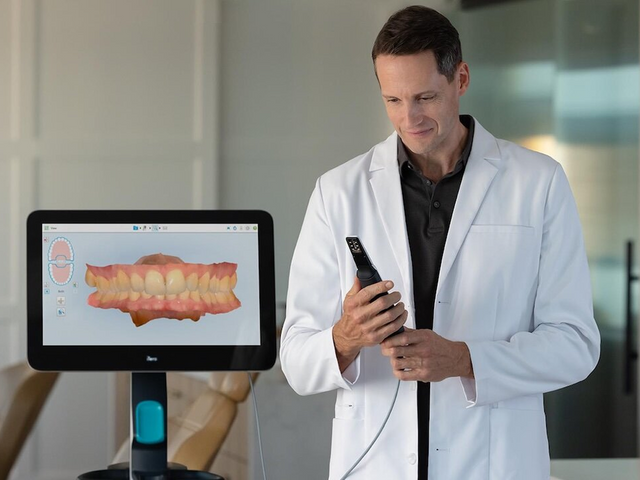
- Intraoral scans accepted for complete dentures, with design files kept; scans reviewed before production (submit a digital case).
- Every case made in house in Brooklyn by more than 35 technicians, no outsourcing, since 2007.
- Send a case: free pickup and delivery by our own drivers in all five New York City boroughs and 13 northern New Jersey counties, or a prepaid UPS label anywhere. Call 877-335-5221.
FAQ
When should an immediate denture get a hard reline?
When the ridge has stabilized and the fit has changed: sources describe 6 months or later, often 6 to 9 months.
Can the patient take the denture out the first night?
Published protocols say no: leave it in until the next-day visit. Some reviews cite 48 hours.
How much should the cast be trimmed?
Only as much as the planned surgery removes. One case series trimmed 2 mm buccally and 1 mm lingually, guided by a radiograph.
Can an immediate denture be made from intraoral scans?
Clinical reports describe fully digital and hybrid workflows. Scans miss functional borders, so many add a border-molded impression.
Should I graft the sockets under an immediate denture?
In one randomized trial, first-year buccal height loss was 0.7 mm with a graft and 2.1 mm without; the authors see most value when implants are planned.
Is an immediate denture temporary?
It can be either: a conventional immediate denture is relined and kept; an interim one is replaced after healing.
Sources (23)
- Layton DM, Morgano SM, Att W, et al., eds. The Glossary of Prosthodontic Terms 2023: Tenth Edition. J Prosthet Dent. 2023;130(4 Suppl 1):e1-e126. doi:10.1016/j.prosdent.2023.03.003
- Yeung C, et al. Prosthodontic Rehabilitation and Follow-Up Using Maxillary Complete Conventional Immediate Denture. Clin Cosmet Investig Dent. 2020;12:437-445. doi:10.2147/CCIDE.S271304
- Sikri A, et al. Immediate Complete Dentures: A Systematic Review. J West Afr Coll Surg. 2025;15(4):371-379. doi:10.4103/jwas.jwas_133_24
- Farrag A, et al. Digital hybrid technique for immediate complete denture fabrication: A clinical report. J Prosthodont. 2025;34(9):892-899. doi:10.1111/jopr.70023
- Oh KC, Kim JH, Moon HS. Two-visit placement of immediate dentures with the aid of digital technologies. J Am Dent Assoc. 2019;150(7):618-623. doi:10.1016/j.adaj.2019.02.022
- Tallgren A, et al. Roentgen cephalometric analysis of ridge resorption and changes in jaw and occlusal relationships in immediate complete denture wearers. J Oral Rehabil. 1980;7(1):77-94. doi:10.1111/j.1365-2842.1980.tb01466.x
- Foundation for Oral Rehabilitation (FOR). Immediate dentures. Treatment guidelines: edentulous, mucosally supported. for.org
- Michael CG, Barsoum WM. Comparing ridge resorption with various surgical techniques in immediate dentures. J Prosthet Dent. 1976;35(2):142-155. doi:10.1016/0022-3913(76)90273-0
- Fang JH, et al. Digital immediate denture: A clinical report. J Prosthet Dent. 2018;119(5):698-701. doi:10.1016/j.prosdent.2017.06.004
- Badr Z, et al. Digitally-Driven Surgical Guide for Alveoloplasty Prior to Immediate Denture Placement. Dent J (Basel). 2025;13(8):333. doi:10.3390/dj13080333
- Alamri O, et al. An analog-digital hybrid technique for immediate dentures with idealized border extensions. J Prosthet Dent. 2025;133(2):352-356. doi:10.1016/j.prosdent.2023.03.032
- Neumeier TT, Neumeier H. Digital immediate dentures treatment: A clinical report of two patients. J Prosthet Dent. 2016;116(3):314-319. doi:10.1016/j.prosdent.2016.01.010
- Millet C, et al. CAD-CAM immediate to definitive complete denture transition: A digital dental technique. J Prosthet Dent. 2020;124(6):642-646. doi:10.1016/j.prosdent.2019.10.025
- Tan WL, et al. A systematic review of post-extractional alveolar hard and soft tissue dimensional changes in humans. Clin Oral Implants Res. 2012;23 Suppl 5:1-21. doi:10.1111/j.1600-0501.2011.02375.x
- Couso-Queiruga E, et al. Post-extraction dimensional changes: A systematic review and meta-analysis. J Clin Periodontol. 2021;48(1):126-144. doi:10.1111/jcpe.13390
- Rignon-Bret C, et al. Radiographic evaluation of a bone substitute material in alveolar ridge preservation for maxillary removable immediate dentures: A randomized controlled trial. J Prosthet Dent. 2022;128(5):928-935. doi:10.1016/j.prosdent.2021.02.013
- van Waas MA, et al. Differences two years after tooth extraction in mandibular bone reduction in patients treated with immediate overdentures or with immediate complete dentures. J Dent Res. 1993;72(6):1001-1004. doi:10.1177/00220345930720060101
- D'Souza NL, et al. Comparison of postinsertion adjustments between conventional and immediate complete dentures and their association with denture survival. J Prosthet Dent. 2025;134(4):1207.e1-1207.e8 (erratum 2026;136(1):331-332). doi:10.1016/j.prosdent.2025.06.025
- Felton D, et al. Evidence-based guidelines for the care and maintenance of complete dentures: a publication of the American College of Prosthodontists. J Prosthodont. 2011;20 Suppl 1:S1-S12. doi:10.1111/j.1532-849X.2010.00683.x
- American Dental Association, MouthHealthy. Dentures. mouthhealthy.org
- Holt RA Jr. Instructions for patients who receive immediate dentures. J Am Dent Assoc. 1986;112(5):645-646. doi:10.14219/jada.archive.1986.0064
- Dorocka-Bobkowska B, Medyński D, Pryliński M. Recent advances in tissue conditioners for prosthetic treatment: A review. Adv Clin Exp Med. 2017;26(4):723-728. doi:10.17219/acem/62634
- Canadian Agency for Drugs and Technologies in Health (CADTH). Longevity of Relined or Rebased Dentures: Health Technologies. CADTH Health Technology Review, Report RC1592, May 2026. PubMed 42330140
Reviewed by Gary Fingerman, founder and CEO of Elegant Dental Laboratory, Brooklyn, New York (founded 2007). Last reviewed: October 1, 2026. Study values are from published research and clinical reports; reline and remake timing should follow the clinical findings in each patient.