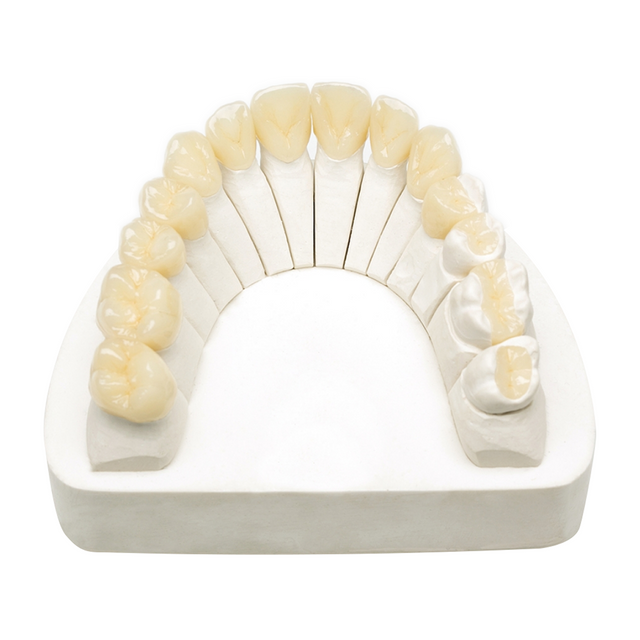
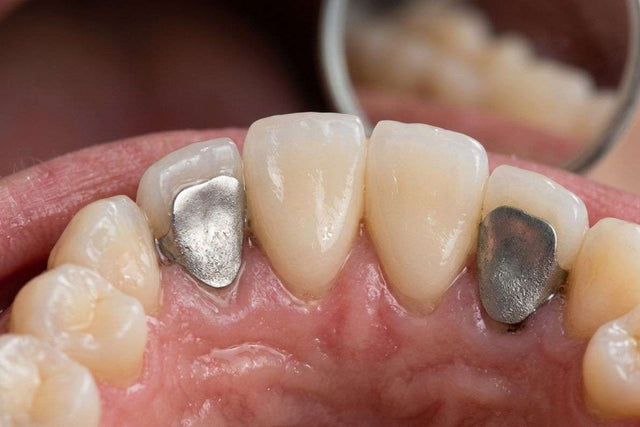
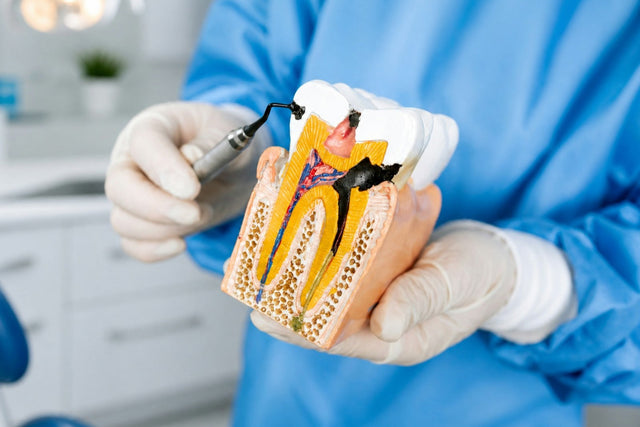
A patient has lost a lower first molar, the teeth on either side are sound, and the question comes up: bridge or implant? Give the same neighbors large old fillings and the answer changes. Survival figures get quoted both ways, often from a single study.
Below: what the systematic reviews report at 5 and 10 years, the complications of each option, the cost in tooth structure and time, who should not get an implant, and a decision table.
Wondering whether a lost tooth could be regrown instead? See Is Tooth Regeneration Possible? What Research Really Says.
Key Takeaways
- Pooled survival is nearly identical: 93.8% for conventional bridges and 94.5% for implant crowns at 5 years, 89.2% and 89.4% at 10 years.
- In studies with 10 years of follow-up, annual failure rates were 1.14% for conventional bridges and 1.12% for implant crowns.
- The most frequent bridge complications are biological (caries, loss of vitality); implant restorations have more technical ones, including 8.8% screw loosening over 5 years for implant crowns (46 studies).
- Peri-implantitis affected 19.53% of patients and 12.53% of implants in a meta-analysis of 57 articles.
- Complete-crown preparations removed 67.5% to 75.6% of a posterior tooth's coronal structure in a lab study; a 3-unit bridge needs two.
- In a 2026 review of 41 studies, veneered zirconia (92.9%) and metal-ceramic (91.3%) bridges had similar 5-year survival; lithium disilicate bridges trailed at 82.5%.
Quick Answer
On survival it is close to a tie: pooled 10-year survival is 89.2% for conventional tooth-supported bridges and 89.4% for implant crowns. Decide by the neighbors and the site. With sound adjacent teeth and adequate bone, an implant crown spares two teeth from crown preparations. When the neighbors already need crowns, or bone, health, timing or budget rule out an implant, a bridge is an equally evidence-based choice.
What Do 5- and 10-Year Studies Show?
The classic systematic reviews
The best-known comparison, a 2007 review by Pjetursson, Brägger, Lang and Zwahlen of cohort studies with a mean follow-up of at least 5 years, estimated survival of conventional tooth-supported bridges at 93.8% after 5 years and 89.2% after 10; implant crowns reached 94.5% and 89.4%. Cantilever bridges fell to 80.3% at 10 years.
The separate reviews agree: 19 studies of conventional bridges gave 89.1% at 10 years (Tan et al., 2004), and 46 studies of implant crowns gave 96.3% at 5 years and 89.4% at 10, with the implants themselves at 97.2% and 95.2% (Jung et al., 2012). These reviews pool bridges of different spans, not only 3-unit ones.
Annual failure rate in 10-year studies for both options: 1.14% for conventional bridges and 1.12% for implant crowns, from six systematic reviews (Pjetursson, Zwahlen and Lang, 2012).
A 15-year comparison of 3-unit bridges
Walton (2015) followed sequential patients in one prosthodontic practice who received a metal-ceramic 3-unit bridge (174) or an implant crown (220) from 1996 to 2010. For posterior teeth, 15-year survival did not differ: 92.75% for bridges, 95.95% for implant crowns. For anterior teeth, implant crowns did significantly better, 93.33% against 82.82%. Seventeen bridges judged unfavorable at insertion were excluded.
What the 2026 update adds: material matters
Romandini, Pjetursson, Sailer and colleagues pooled 41 studies of 600 metal-ceramic and 1,532 all-ceramic multiple-unit bridges (mean follow-up at least 3 years). Five-year survival was 92.9% for veneered zirconia, 91.3% for metal-ceramic, 87.9% for monolithic zirconia and 82.5% for lithium disilicate; only lithium disilicate was significantly below metal-ceramic. After 5 years, 71.0% were complication-free, and monolithic zirconia chipped least.
| Outcome | Tooth-supported bridge | Single implant crown |
|---|---|---|
| Survival at 5 years | 93.8% | 94.5% |
| Survival at 10 years | 89.2% (89.1% in 19 studies) | 89.4% (46 studies); implant 95.2% |
| Annual failure rate, 10-year studies | 1.14% | 1.12% |
| Most frequent problems | Biological: caries, loss of pulp vitality | Technical: veneer fracture, screw or abutment loosening, loss of retention |
| Selected complications | 10 years: loss of retention 6.4%, material fracture 3.2%, lost to caries 2.6% | 5 years: screw loosening 8.8%, soft tissue 7.1%, loss of retention 4.1%, veneer fracture 3.5% |
| Tooth reduction | 67.5% to 75.6% of coronal structure per posterior abutment (typodont study) | None on the neighbors |

Which Biological Complications Should You Expect?
Bridges: caries and pulp problems in the abutments
Caries and loss of pulp vitality were the most frequent complications of conventional bridges in the 2007 review. Within 10 years, 2.6% of bridges were lost to caries and 0.7% to periodontitis (Tan et al., 2004). Goodacre's 2003 review, pooling studies of different lengths, found caries at 18% of abutments and endodontic treatment needed at 11%. In a 25-year Oslo cohort of mostly bridge retainers, 92% of crowned vital teeth were free of pulpal deterioration at 10 years and 83% at 25.
Implant crowns: mucositis and peri-implantitis
Over 5 years, Jung's review calculated a cumulative soft tissue complication rate of 7.1%, and bone loss over 2 mm at 5.2% of implants. Prevalence studies report more: a 2015 meta-analysis of 11 studies estimated 43% for peri-implant mucositis and 22% for peri-implantitis (Derks and Tomasi, 2015), and a 2022 meta-analysis of 57 articles found peri-implantitis in 19.53% of patients and 12.53% of implants (Diaz et al., 2022).
Which Technical Complications Should You Expect?
Bridges: retention and fractures
Over 10 years, conventional bridges lost retention in 6.4%, had abutment fractures in 2.1% and material fractures in 3.2% (Tan et al., 2004). In the 2026 review, framework fractures exceeded 10% over 5 years for lithium disilicate and glass-infiltrated alumina bridges; the authors call these weaker ceramics unsuitable for multiunit restorations.
Implant crowns: screws, retention and chipping
Implant reconstructions had significantly more technical complications than tooth-supported bridges (Pjetursson et al., 2007). Over 5 years, Jung's review found screw loosening in 8.8%, loss of retention in 4.1% and veneer fracture in 3.5%. In a 2021 review of 49 studies, monolithic ceramic implant crowns chipped at 0.39% a year, veneered ones at 1.65% (Pjetursson et al., 2021). See Screw-Retained vs. Cement-Retained Implant Crowns and Implant Screw Loosening.

How Much Healthy Tooth Does a Bridge Cost?
Share of coronal tooth structure removed by a complete-crown preparation on a posterior typodont tooth, at most; 67.5% at least, depending on the design. A 3-unit bridge needs two (Edelhoff and Sorensen, 2002).
Adhesive and inlay-type preparations removed about 5.5% to 27.2%; on anterior teeth, crown preparations removed about 63% to 72%. An economic review by Scheuber, Hicklin and Brägger (2012) concluded that the value of keeping healthy adjacent teeth unprepared makes the implant crown more economic.
When the neighbors already need crowns
If both neighbors already carry large restorations or need full coverage anyway, the bridge adds a pontic instead of surgery. The same review found that the condition of the neighboring teeth and of the ridge defined the complexity and cost of treatment.
How Long Until the Final Restoration?
A bridge is prepared, scanned and provisionalized at one visit and seated at the next; our turnaround on most restorative cases is from 5 business days. An implant follows the healing clock. A 2026 review of 140 studies and 10,456 implants used these definitions: placement immediate (at extraction), early (4 to 8 or 12 to 16 weeks) or late (after more than 6 months); loading immediate (within 1 week), early (1 week to 2 months) or conventional (after 2 months).
Late placement with conventional loading reached 97.5% weighted cumulative survival, immediate placement with immediate restoration 98.0% (Gallucci et al., 2026). Immediate loading needs careful case selection, including sufficient buccal bone thickness and primary stability.
Bone and soft tissue
In a review of 20 studies, sockets lost 3.79 mm of width and 1.24 mm of buccal height within 6 months of extraction, fastest in the first 3 to 6 months (Tan et al., 2012). A narrowed ridge may need grafting, which adds visits and healing time. A pontic needs no bone.
For ridge changes under an immediate denture and when to reline, see Immediate Dentures: Records, Surgery Day and the First Year of Relines.
Who Should Not Get an Implant?
Oncology patients on antiresorptive or antiangiogenic drugs
The 2022 AAOMS position paper says implant placement should be avoided in oncology patients receiving parenteral antiresorptive therapy or antiangiogenic medications. For osteoporosis patients, it asks for informed consent covering the low risk of osteonecrosis and possible early or late implant failure, then long-term recall.
Smokers
A meta-analysis of 292 publications found higher implant failure in smokers (odds ratio 2.4) and 0.58 mm more marginal bone loss (Mustapha et al., 2021). A risk to discuss, not an absolute bar.
Adolescents
Implants do not move with the growing dentoalveolar complex. A 2020 review notes that facial growth and tooth eruption continue into the second and third decades and advises delaying anterior maxillary implants in adolescents where possible (Mijiritsky et al., 2020). A resin-bonded bridge can hold the space: across 2,300 bridges, survival was 91.4% at 5 years and 82.9% at 10, with debonding the most common complication (Thoma et al., 2017). More in Maryland Bridges.
What About Cost and Insurance?
Fees vary too much to quote, but the structure differs: a bridge is three units of lab work on two prepared teeth; an implant crown adds surgery, the implant, an abutment and sometimes grafting to one crown. A review of 26 publications found similar initial costs (varying between tariff systems), failure rates and long-term financial outcomes (Scheuber et al., 2012).
Coverage differs by plan: check whether implants are covered, how the treatment fits the annual maximum, and whether the plan limits replacing a tooth lost before coverage began. Original Medicare does not cover implants in most cases. For coding, see CDT Codes for Dental Lab Work.
Bridge or Implant: Which Fits This Patient?
| Situation | Better choice | Why |
|---|---|---|
| Sound, unrestored neighbors; adequate bone; adult | Implant crown | Similar 10-year survival, and two teeth keep their enamel |
| Both neighbors already need crowns | 3-unit bridge | The preparations are needed anyway; no surgery |
| Missing anterior tooth, adult, good bone | Implant crown | 15-year survival 93.33% against 82.82% in one cohort |
| Missing posterior tooth, both feasible | Either; patient preference | 95.95% against 92.75% at 15 years, not significantly different |
| Resorbed ridge, patient declines grafting | 3-unit bridge | A pontic needs no bone; grafting adds time |
| Oncology patient on IV antiresorptives or antiangiogenics | 3-unit bridge | AAOMS advises avoiding implants |
| Adolescent with a missing incisor | Resin-bonded bridge now, implant later | Implants do not follow growth and eruption |
| Patient wants a fixed tooth quickly | 3-unit bridge | Prep and seat visits; conventional implant loading waits 2 months |

Bridges and Implant Crowns at Elegant Dental Laboratory
- Digital scans are reviewed before production, and every case is made in house in Brooklyn by more than 35 technicians.
- Zirconia (solid, 9-layer, solid with buccal porcelain, or a zirconia coping with layered porcelain) and PFM in base and precious alloys.
- Implant restorations: screw-retained and cement-retained options and custom screw-retained abutments.
- Turnaround from 5 business days on most restorative cases, rush decided case by case, up to a 7-year warranty on final restorations and up to 20 years on screw-retained implant abutments (policies and warranties).
- Submit a digital case or send a case: our own drivers pick up free every business day in the five NYC boroughs and 13 northern New Jersey counties, and UPS labels work anywhere. Call 877-335-5221.
Related Guides
- PFM vs. Zirconia Crowns in 2026: When Metal-Ceramic Still Makes Sense
- Types of Zirconia Explained: 3Y, 4Y, 5Y, Multilayer, Monolithic and Layered
- Why Crowns Come Back High or With Open Contacts, and How to Prevent It
FAQ
Does an implant crown last longer than a 3-unit bridge?
Not on pooled data: 89.4% against 89.2% at 10 years. In one 15-year cohort, implant crowns did better for anterior teeth.
What usually goes wrong with a bridge?
Caries and loss of vitality in the abutments. Loss of retention is the most common technical problem, 6.4% over 10 years.
What usually goes wrong with an implant crown?
Screw loosening, 8.8% over 5 years, then loss of retention and chipping. Mucositis and peri-implantitis call for regular maintenance.
Which material should I choose for a 3-unit bridge?
Zirconia or metal-ceramic. Lithium disilicate bridges had the lowest 5-year survival in the 2026 review, 82.5%.
How long does an implant crown take compared with a bridge?
A bridge needs a preparation visit and a seating visit. Conventional implant loading comes after 2 months; late placement adds more than 6 months of healing after extraction.
Sources (23)
- Pjetursson BE, Brägger U, Lang NP, Zwahlen M. Comparison of survival and complication rates of tooth-supported fixed dental prostheses (FDPs) and implant-supported FDPs and single crowns (SCs). Clin Oral Implants Res. 2007;18 Suppl 3:97-113. doi:10.1111/j.1600-0501.2007.01439.x
- Tan K, Pjetursson BE, Lang NP, Chan ES. A systematic review of the survival and complication rates of fixed partial dentures (FPDs) after an observation period of at least 5 years. Clin Oral Implants Res. 2004;15(6):654-666. doi:10.1111/j.1600-0501.2004.01119.x
- Jung RE, Zembic A, Pjetursson BE, Zwahlen M, Thoma DS. Systematic review of the survival rate and the incidence of biological, technical, and aesthetic complications of single crowns on implants reported in longitudinal studies with a mean follow-up of 5 years. Clin Oral Implants Res. 2012;23 Suppl 6:2-21. doi:10.1111/j.1600-0501.2012.02547.x
- Pjetursson BE, Zwahlen M, Lang NP. Quality of reporting of clinical studies to assess and compare performance of implant-supported restorations. J Clin Periodontol. 2012;39 Suppl 12:139-159. doi:10.1111/j.1600-051X.2011.01828.x
- Walton TR. An up-to-15-year comparison of the survival and complication burden of three-unit tooth-supported fixed dental prostheses and implant-supported single crowns. Int J Oral Maxillofac Implants. 2015;30(4):851-861. doi:10.11607/jomi.4220
- Romandini P, Pjetursson BE, Pitta J, Balet A, Ikumi R, Sailer I. A systematic review and meta-analysis evaluating the survival, failure, and complication rates of metal-ceramic, veneered, and monolithic all-ceramic tooth-supported multiple-unit fixed dental prostheses (FDPs), Part 2. Int J Prosthodont. 2026;39(4):444-462. doi:10.11607/ijp.9666
- Pjetursson BE, Sailer I, Latyshev A, Rabel K, Kohal RJ, Karasan D. A systematic review and meta-analysis evaluating the survival, the failure, and the complication rates of veneered and monolithic all-ceramic implant-supported single crowns. Clin Oral Implants Res. 2021;32 Suppl 21:254-288. doi:10.1111/clr.13863
- Goodacre CJ, Bernal G, Rungcharassaeng K, Kan JY. Clinical complications in fixed prosthodontics. J Prosthet Dent. 2003;90(1):31-41. doi:10.1016/s0022-3913(03)00214-2
- Valderhaug J, Jokstad A, Ambjørnsen E, Norheim PW. Assessment of the periapical and clinical status of crowned teeth over 25 years. J Dent. 1997;25(2):97-105. doi:10.1016/s0300-5712(96)00008-5
- Derks J, Tomasi C. Peri-implant health and disease. A systematic review of current epidemiology. J Clin Periodontol. 2015;42 Suppl 16:S158-S171. doi:10.1111/jcpe.12334
- Diaz P, Gonzalo E, Villagra LJG, Miegimolle B, Suarez MJ. What is the prevalence of peri-implantitis? A systematic review and meta-analysis. BMC Oral Health. 2022;22(1):449. doi:10.1186/s12903-022-02493-8
- Edelhoff D, Sorensen JA. Tooth structure removal associated with various preparation designs for posterior teeth. Int J Periodontics Restorative Dent. 2002;22(3):241-249. PubMed 12186346
- Edelhoff D, Sorensen JA. Tooth structure removal associated with various preparation designs for anterior teeth. J Prosthet Dent. 2002;87(5):503-509. doi:10.1067/mpr.2002.124094
- Scheuber S, Hicklin S, Brägger U. Implants versus short-span fixed bridges: survival, complications, patients' benefits. A systematic review on economic aspects. Clin Oral Implants Res. 2012;23 Suppl 6:50-62. doi:10.1111/j.1600-0501.2012.02543.x
- Gallucci GO, Hamilton A, Akhondi S, Pala K, Peña-Cardelles JF. Current state of evidence for implant placement and loading in partially edentulous patients: a systematic review. Clin Implant Dent Relat Res. 2026;28(1):e70120. doi:10.1111/cid.70120
- Tan WL, Wong TL, Wong MC, Lang NP. A systematic review of post-extractional alveolar hard and soft tissue dimensional changes in humans. Clin Oral Implants Res. 2012;23 Suppl 5:1-21. doi:10.1111/j.1600-0501.2011.02375.x
- Ruggiero SL, Dodson TB, Aghaloo T, Carlson ER, Ward BB, Kademani D. American Association of Oral and Maxillofacial Surgeons' position paper on medication-related osteonecrosis of the jaws, 2022 update. J Oral Maxillofac Surg. 2022;80(5):920-943. doi:10.1016/j.joms.2022.02.008
- Mustapha AD, Salame Z, Chrcanovic BR. Smoking and dental implants: a systematic review and meta-analysis. Medicina (Kaunas). 2021;58(1):39. doi:10.3390/medicina58010039
- Mijiritsky E, Badran M, Kleinman S, Manor Y, Peleg O. Continuous tooth eruption adjacent to single-implant restorations in the anterior maxilla: aetiology, mechanism and outcomes. A review of the literature. Int Dent J. 2020;70(3):155-160. doi:10.1111/idj.12549
- Thoma DS, Sailer I, Ioannidis A, Zwahlen M, Makarov N, Pjetursson BE. A systematic review of the survival and complication rates of resin-bonded fixed dental prostheses after a mean observation period of at least 5 years. Clin Oral Implants Res. 2017;28(11):1421-1432. doi:10.1111/clr.13007
- Sauvin G, Nurdin N, Bischof M, Kiliaridis S. Assessment and aesthetic impact of a long-term vertical discrepancy between the single anterior maxillary implant-supported crown and adjacent teeth: a retrospective cross-sectional study. Clin Exp Dent Res. 2022;8(5):1109-1116. doi:10.1002/cre2.629
- Zitzmann NU, Krastl G, Weiger R, Kühl S, Sendi P. Cost-effectiveness of anterior implants versus fixed dental prostheses. J Dent Res. 2013;92(12 Suppl):183S-188S. doi:10.1177/0022034513504927
- Medicare.gov. Dental services (coverage page). medicare.gov/coverage/dental-services
Reviewed by Gary Fingerman, founder and CEO of Elegant Dental Laboratory, Brooklyn, New York (founded 2007). Last reviewed: September 28, 2026. Study values are from published research and pooled across different patients and designs; the right choice depends on the individual patient.