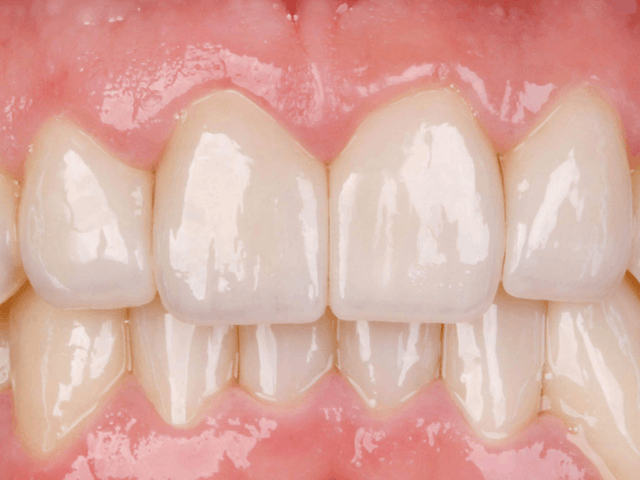
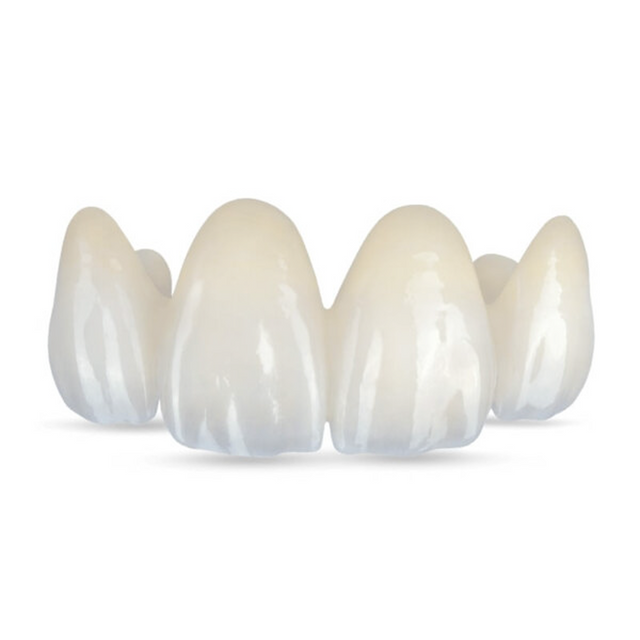
What makes a smile look natural? Not one magic number. Smile design rests on a few tooth proportions that vary from person to person, on how the teeth sit inside the lips, and on symmetry between the left and right side. The famous golden proportion, which says each front tooth should look about 62% as wide as the one in front of it, is not found in most natural smiles.
The idea is older than digital dentistry. A 1978 paper in the Journal of Prosthetic Dentistry tied dental esthetics to the golden proportion, a ratio used since antiquity by artists and designers, and gave dentists a grid to lay over the front teeth.
Research has tested that grid many times since. Below are the five beliefs about smile design we hear most often, each with what the studies actually found and what it means for a case you send to the lab.
Myth: A Beautiful Smile Follows the Golden Proportion
Viewed from the front, the rule says the lateral incisor looks 62% as wide as the central, and the canine 62% as wide as the lateral. It is easy to draw on a photo. It just does not describe most natural smiles.
A 2026 review in the Journal of Prosthetic Dentistry went through the published work on the golden proportion: 6 studies that compared it with natural teeth and 7 systematic reviews. None of them supported a link between the golden proportion and natural dentitions. Its conclusion was blunt: the golden proportion is not a valid guide for the design of anterior teeth.
People from 12 countries, measured in 26 studies of a 2024 meta-analysis of tooth-width formulas. None of the formulas gave consistent results (J Prosthet Dent 2024).
Other formulas fared no better. A 2022 systematic review of 16 studies did not find the "golden percentage" (25%, 15% and 10% for the central, the lateral and the canine) in natural teeth. A 2019 review of 41 studies found that only one rule, the recurring esthetic dental (RED) proportion of 70%, combined with the width of the nose at the nostrils, predicted the combined width of the central incisors well.
Dentists' own eyes agree. In a web survey of 549 dentists in 38 countries, the golden proportion was judged best only when the teeth were very tall, and worst when they were of normal height or shorter; for short teeth, an 80% proportion won.

Myth: There Is One Ideal Width-to-Length Ratio
The width-to-length ratio of the central incisor is the proportion people notice first. But the "ideal" moves with wear.
A 2003 study measured 146 extracted upper anterior teeth. Unworn central incisors were on average 11.69 mm long, with a width of about 78% of their length. Worn centrals were the same width but shorter, so their ratio rose to 87%. Unworn laterals and canines were both about 73%. A 1999 study that measured clinical crowns on models found central incisors at 0.85 in men and 0.86 in women, and an average of 0.81 across the three anterior tooth groups.
| Smile design number | What research found | What it means for a case |
|---|---|---|
| Central incisor width to length | 78% unworn, 87% worn (146 extracted teeth); about 85% on clinical crowns | Treat it as a range, not a target; worn teeth read square because they lost length |
| Lateral width as a share of central | The 62% golden proportion is not found in natural teeth (2026 review) | Let the face, the arch and the patient's own teeth set the widths |
| Midline off center | General dentists and lay people did not notice even 4 mm | A slightly off midline is rarely the problem; a tilted one is |
| Crown tilt or width side to side | A 2 mm difference was noticed by dentists and lay people | Match left and right before anything else |
| Gum shown above the teeth | Rated unattractive by lay people at 3 to 4 mm | Flag a high lip line on the Rx and in photos |

Myth: The Midline Has to Be Perfect
In a 1999 study, smiling photos were altered and rated by orthodontists, general dentists and lay people. General dentists and lay people could not detect even a 4 mm shift of the upper midline. Yet all three groups spotted a 2 mm difference in the tilt of the incisor crowns. A 2006 follow-up found that all three groups noticed a 2 mm difference in crown width between one side and the other, while a small midline diastema was not rated unattractive by any group.
The lesson: keep the midline vertical and the two centrals mirror images of each other. A midline a little to one side is usually fine; a canted one is not.
Myth: Smile Design Is About the Teeth Alone
Teeth are always seen inside a frame of lips and gums. In a 1984 study of 454 full-face photographs, an average smile showed about the full length of the upper anterior teeth, the incisal curve ran parallel to the inner curve of the lower lip, and the smile displayed the six upper anterior teeth and the premolars.
The frame also changes with age. A 1978 survey of tooth display found that the amount of upper central incisor shown with the lips at rest gradually falls with age, while more of the lower teeth show.
Gum display matters too. In the 1999 study, general dentists and lay people rated a 4 mm distance from the gingiva to the lip as noticeably unattractive, and in 2006 orthodontists and lay people already marked 3 mm. If the patient shows that much gum, raise it before the wax-up.

Myth: Design Software Builds Teeth by the Golden Rule
The 2026 review checked this too. In the default library of 17 anterior tooth molds in exocad, only 4 had a lateral-to-central proportion close to the golden 62% (61 to 68%); the other 13 measured 73 to 87%. None of the canine-to-lateral proportions came close. The five denture tooth molds most often chosen for one brand of digital dentures measured 71 to 82%.
The libraries copy real teeth, and real teeth are wider than the golden rule. A smile preview from an app is a picture to agree on; the final widths still come from the patient's mouth. Our guide to AI smile simulation for case acceptance covers what such a preview can and cannot show.

What to Send Us So the Design Starts From the Face
Elegant Dental Laboratory, a full-service lab in Brooklyn, makes the diagnostic wax-up, the mock-up and the reduction guide for esthetic cases, and we design with exocad and 3Shape. What helps most is everything that shows the frame around the teeth:
- A full-face photo with a natural smile, and one with the lips at rest.
- A retracted photo of the anterior teeth, and shade photos by email.
- A stump shade for anterior all-ceramic crowns.
- The patient-approved smile preview or smile design file, if there is one: we accept face photos and smile design files and keep esthetic design files.
- Notes on the Rx: the midline, the incisal edge position, and whether the patient wants a change in length or width.
See also our anterior esthetic case checklist, shade photos and the stump shade and veneer prep with reduction guides. We press veneers and crowns with IPS e.max Press, with turnaround from 5 business days. When the photos and the approved mock-up are ready, send the case or call 877-335-5221.
In Short
- The 62% golden proportion is not found in natural teeth.
- Central incisors are about 78% wide to long, 87% when worn: a range, not a number.
- A 4 mm midline shift goes unnoticed; a 2 mm tilt does not. Symmetry first.
- Lips, age and gum display frame the smile: send face photos, not only a scan.
Sources (12)
- Levin EI. Dental esthetics and the golden proportion. J Prosthet Dent. 1978;40(3):244-252. doi:10.1016/0022-3913(78)90028-8
- Goodacre C, Goldstein G. Should the golden ratio be used in CAD-CAM dentistry? J Prosthet Dent. 2026;135(3):593.e1-593.e8. doi:10.1016/j.prosdent.2025.10.005
- Özdemir H, Özdemir M. Evaluation of the parameters related to the golden ratio in the teeth of individuals from different countries: a systematic review and meta-analysis. J Prosthet Dent. 2024;132(4):726-734. doi:10.1016/j.prosdent.2023.09.032
- Ahmed N, Halim MS, Khalid S, Ghani ZA, Jamayet NB. Evaluation of golden percentage in natural maxillary anterior teeth width: a systematic review. J Prosthet Dent. 2022;127(6):845.e1-845.e9. doi:10.1016/j.prosdent.2021.06.015
- Liao P, Fan Y, Nathanson D. Evaluation of maxillary anterior teeth width: a systematic review. J Prosthet Dent. 2019;122(3):275-281.e7. doi:10.1016/j.prosdent.2018.10.015
- Rosenstiel SF, Ward DH, Rashid RG. Dentists' preferences of anterior tooth proportion: a web-based study. J Prosthodont. 2000;9(3):123-136. PubMed 11179463
- Magne P, Gallucci GO, Belser UC. Anatomic crown width/length ratios of unworn and worn maxillary teeth in white subjects. J Prosthet Dent. 2003;89(5):453-461. doi:10.1016/S0022-3913(03)00125-2
- Sterrett JD, Oliver T, Robinson F, et al. Width/length ratios of normal clinical crowns of the maxillary anterior dentition in man. J Clin Periodontol. 1999;26(3):153-157. doi:10.1034/j.1600-051x.1999.260304.x
- Kokich VO Jr, Kiyak HA, Shapiro PA. Comparing the perception of dentists and lay people to altered dental esthetics. J Esthet Dent. 1999;11(6):311-324. doi:10.1111/j.1708-8240.1999.tb00414.x
- Kokich VO, Kokich VG, Kiyak HA. Perceptions of dental professionals and laypersons to altered dental esthetics: asymmetric and symmetric situations. Am J Orthod Dentofacial Orthop. 2006;130(2):141-151. doi:10.1016/j.ajodo.2006.04.017
- Tjan AH, Miller GD, The JG. Some esthetic factors in a smile. J Prosthet Dent. 1984;51(1):24-28. doi:10.1016/s0022-3913(84)80097-9
- Vig RG, Brundo GC. The kinetics of anterior tooth display. J Prosthet Dent. 1978;39(5):502-504. doi:10.1016/s0022-3913(78)80179-6