In 14 randomized trials, CPAP lowered the apnea-hypopnea index about 7 events per hour more than a mandibular advancement device, yet daytime sleepiness did not differ. That is the short answer to where oral appliances fit: almost always custom mandibular advancement devices, they are the main alternative for adults with obstructive sleep apnea who cannot tolerate or do not want CPAP, and a treatment for primary snoring, once a sleep physician has made the diagnosis and prescribed them. Choose a custom, titratable design, expect gradual bite changes and plan follow-up sleep testing.
The need is large. An estimated 936 million adults aged 30 to 69 worldwide have mild to severe obstructive sleep apnea and 425 million have moderate to severe disease, by a 2019 analysis in The Lancet Respiratory Medicine, and the US has the second-largest number of affected people. The dentist who fits an appliance is expected to choose a design, set the advancement, watch the bite for years and work with the physician, often with little training in sleep medicine. The sheet below puts the current guideline and the trials on one page; the sections after it explain the rows.
Oral Appliance Therapy on One Page
| Item | Reference point |
|---|---|
| Who does what | |
| Diagnosis and prescription | Sleep physician, for primary snoring or for obstructive sleep apnea in adults who are intolerant of CPAP or prefer an alternative |
| Providing the appliance | A qualified dentist, with a custom, titratable device rather than a non-custom one |
| Follow-up | Dentist: dental side effects and occlusal changes. Sleep physician: a sleep test with the appliance in place after titration. Both: periodic visits |
| Design choices | |
| Custom or prefabricated | Custom: 60% success against 31% for a thermoplastic device that cannot be titrated, which often failed to stay in overnight. A titratable heat-molded device was non-inferior to custom at 2 months, with more side effects |
| One piece or two | Equivalent apnea reduction and side effects at about 2 months |
| How far to advance | Trials used 50% to 89% of maximum protrusion; beyond 50% gave no significant gain in success on average. Titrate to the patient's effective position |
| What the lab needs | |
| Prescription | The physician's referral, noted in the chart and on the Rx |
| Records | Full-arch impressions or scans of both arches, with restorations, partial dentures and implants noted |
| Bite | A registration in the starting position, the vertical opening and the maximum protrusion |
| Design | One piece or two, titratable or fixed, and any limits on the arch |
| What to expect over time | |
| Bite | Overbite down 2.3 mm and overjet down 1.9 mm after an average of 11.1 years, still progressing. Keep a baseline and compare at each recall |
| Wear | Above 80% adherence out to 1 year in small sensor studies; in a pilot of 49 adults, 3.7 nights a week and 44% adherent at 12 months. Ask at every visit |
The Physician Prescribes, the Dentist Provides and Follows
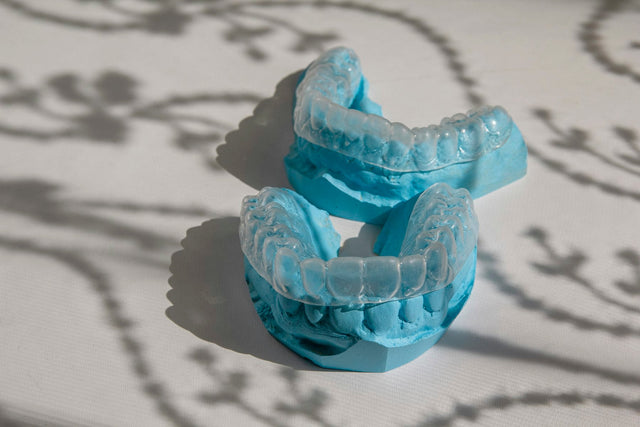
A sleep physician writes that a patient cannot tolerate CPAP and asks you to fit an oral appliance, or a snoring spouse asks whether "one of those mouthpieces" would help. Either way, the roles come from the joint 2015 guideline of the American Academy of Sleep Medicine and the American Academy of Dental Sleep Medicine. A sleep physician diagnoses the patient and prescribes the oral appliance. A qualified dentist provides it, using a custom, titratable device rather than a non-custom one, and follows the patient to catch dental side effects and occlusal changes. The sleep physician orders follow-up sleep testing to confirm that the appliance works, and both see the patient periodically.
For the dentist, the work does not end at delivery: titration, side effects and coordination with the physician continue for years. In practice a diagnosis and a prescription come before records, and a sleep test with the appliance in place comes after titration. Quieter nights alone do not confirm that the apnea is controlled, which is why the guideline asks for follow-up testing.
The guideline also covers patients without apnea: it recommends that sleep physicians prescribe oral appliances, rather than no therapy, for adults who ask for treatment of primary snoring (AASM and AADSM, J Clin Sleep Med).
CPAP Wins on the Index, Not on Sleepiness or Blood Pressure
CPAP is more efficient at opening the airway; appliances are easier to live with. The pooled results show both sides:
| Outcome | CPAP | Mandibular advancement device |
|---|---|---|
| Apnea-hypopnea index (14 randomized trials, 496 patients) | Lower, by about 7 events per hour | Higher than with CPAP |
| Daytime sleepiness (same trials) | No significant difference | |
| Blood pressure (51 trials, 4,888 patients) | Systolic down 2.5 mm Hg, diastolic down 2.0 mm Hg | Systolic down 2.1 mm Hg, diastolic down 1.9 mm Hg |
| Severe sleep apnea, sleepiness and quality of life (151 patients) | Similar with a titratable appliance | |
| Adherence and preference (same patients) | Lower | Largely in favor of the appliance |
The blood pressure difference between the two treatments was not significant, and the same analysis found that each extra hour of nightly CPAP use lowered systolic pressure by another 1.5 mm Hg. Adherence is one explanation for the similar results: CPAP works better per hour of use, and in the severe-apnea analysis adherence and preference favored the appliance. Even in severe sleep apnea, an individual-patient meta-analysis concluded that a titratable appliance is an effective alternative for patients who are intolerant of CPAP or prefer another therapy.
Custom and Titratable Is the Default Design
Custom or prefabricated
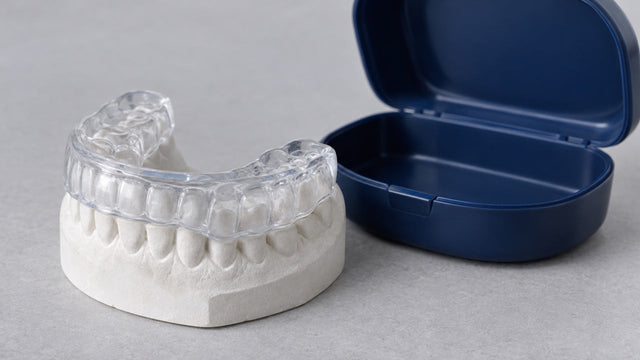
In a randomized crossover trial of 35 patients with mild sleep apnea, only the custom-made appliance reduced the apnea-hypopnea index. Success was 60% with the custom device against 31% with a thermoplastic, boil-and-bite one; a third of patients failed with the thermoplastic device mainly because it did not stay in overnight, and 82% preferred the custom appliance. A later trial of 198 patients found a heat-molded but titratable device non-inferior to a custom acrylic one at 2 months (response 53.6% against 51.7%), though it caused more side effects and adherence was slightly better with the custom appliance.

One piece or two
A multicenter randomized trial of 302 patients compared two-piece (bibloc) and one-piece (monobloc) appliances. The apnea-hypopnea index fell by 13.8 and 12.5 events per hour, which met the trial's test of equivalence, and mild adverse events affected 39% and 40% of patients. The follow-up was short, a median of 56 days.
How far to advance
A meta-regression of 13 randomized trials, with advancement from 50% to 89% of maximum protrusion, found that advancing beyond 50% did not significantly change the success rate. More advancement is not automatically better; a titratable appliance lets you find the patient's own effective position, and a sleep test with the appliance in place confirms it.

How the Appliance Type Is Chosen
Dentists often ask which appliance works best: a Herbst, a front-hook design, a one-piece device. The trials give a plain answer. A 2021 systematic review of 20 randomized trials and six cohort studies found that some designs lowered the apnea index more than others, but the differences were of limited clinical relevance, and no custom design was better than the rest for sleepiness, wear, preference or side effects. A 2025 meta-analysis of 22 studies found that titratable and fixed devices lowered the index about equally, and that custom devices had fewer side effects and better wear than ready-made ones.
So the choice is practical. These are the decisions, and what the studies say about each:
| Decision | What the studies show | How it is usually settled |
|---|---|---|
| Custom or ready-made | Custom did better than thermoplastic devices, with fewer side effects and better wear | Custom, as the guideline suggests |
| Titratable or fixed | About the same drop in the apnea index in pooled studies | Titratable, so the position can be fine-tuned until a sleep test confirms it |
| One piece or two | Equivalent in 302 patients; in a 24-patient crossover, 15 preferred a one-piece device to a two-piece Herbst and 1 preferred the Herbst | Two pieces when the patient needs to open or move the jaw; one piece when simplicity matters more |
| How the jaw is held forward: side rods (Herbst), side wings or a front hook | Front-hook (midline) designs did slightly better on the apnea index in the 2021 review; the difference was of limited clinical relevance | The mechanism you know how to titrate and the patient can handle |
| Vertical opening | 4 mm and 14 mm of opening lowered the index alike in 23 patients; 78% preferred 4 mm | As little opening as the design allows, unless you have a reason |
The rest follows the patient's mouth: how many teeth can hold the appliance, crowns, implants or a partial on either arch and how far the patient can protrude. Put the design on the Rx; if you have no preference between designs, say so, and we will talk it through before we start.
What the Lab Needs From You
- The prescription. We make sleep appliances on prescription; note the physician's referral in the chart and on the Rx.
- Both arches. Full-arch impressions or intraoral scans of the upper and lower teeth, with all restorations, partial dentures and implants noted (scanner connection steps are in How to Send a Scan to a Dental Lab).
- The bite. A bite registration in the starting position, the vertical opening you want and the patient's maximum protrusion; on what a bite scan does and does not capture, see Digital Bite Registration.
- The design. One piece or two, titratable or fixed, and any limits such as a short clinical crown or a removable partial on the arch.

Sleep Appliances From Our Brooklyn Bench
Elegant Dental Laboratory is a full-service lab at 2308 McDonald Ave in Brooklyn, New York, with more than 35 technicians in a 7,000 sq. ft. facility, founded in 2007 by Gary Fingerman. Every case is made in house. We make anti-snoring and sleep apnea appliances on prescription in our lab, along with hard, soft and dual-laminate night guards and the rest of our appliance range. Call us at 877-335-5221 before you send your first sleep appliance case, so we can confirm what to include for the design you have in mind.
Our drivers pick up and deliver free in all five New York City boroughs, Long Island and 13 northern New Jersey counties, and practices anywhere can print a prepaid UPS label. When the records are ready, send a case.
Bite Changes Over Time
This is the part patients rarely hear about. In 77 patients who wore mandibular advancement splints for an average of 11.1 years, overbite decreased by 2.3 mm, overjet by 1.9 mm and lower crowding by 1.3 mm, while lower intercanine and intermolar widths increased. Anterior crossbites and posterior open bites appeared. The authors found no end point: the changes continue as long as the appliance is worn.
Average decrease in overbite in 77 patients after a mean 11.1 years with mandibular advancement splints; overjet fell 1.9 mm, and the changes had not stopped.
A systematic review of 14 studies with at least 4 years of follow-up found the same pattern: upper incisors tipping back, lower incisors tipping forward, smaller overjet and overbite, and a changed occlusal contact area. It called the effects both statistically and clinically significant.
Keep a baseline scan or models and the patient's starting overjet and overbite in the chart. Comparing them at each recall is the simplest way to show the patient, and the physician, how the bite is changing.

Wear Is Worth Measuring
Many appliances now carry a temperature microsensor that records wear. A review of those studies reported adherence above 80% out to 1 year, though in small samples. A 2026 pilot study of 49 adults was less encouraging: patients wore the appliance about 7 hours on the nights they used it, but only 3.7 nights a week. Only 49% met the adherence target at 3 months and 44% at 12 months, and patients overestimated how often they wore it.
Ask about wear at every visit, and read the sensor data when the appliance has a sensor. Wear, the bite and a follow-up sleep test are the three things to recheck for as long as the patient uses the appliance.
FAQ
What is the success rate of a dental appliance for sleep apnea?
It depends on how success is defined and how severe the apnea is. In mild sleep apnea, a custom appliance succeeded in 60% of patients against 31% for a boil-and-bite device; in a trial of 198 patients, 51.7% to 53.6% responded at 2 months. A sleep test with the appliance in place tells you whether it works for your patient.
How is a sleep appliance sized?
It is made from impressions or scans of both arches and a bite taken in the starting position, with the maximum protrusion measured. Trials used 50% to 89% of maximum protrusion, and going past 50% gave no significant gain on average, so the appliance is then titrated to the patient's effective position.
Herbst or front-hook design?
No design has been shown to be clearly better. Front-hook designs did slightly better on the apnea index in a 2021 review, by a margin of limited clinical relevance; choose the mechanism you can titrate and the patient can handle.
What should the Rx say?
The physician's referral, the design, titratable or fixed, the starting position, the vertical opening and anything on the arches that limits the design; our guide to filling out a lab Rx covers the rest of the form.
Sources (17)
- Ramar K, et al. Clinical Practice Guideline for the Treatment of Obstructive Sleep Apnea and Snoring with Oral Appliance Therapy: An Update for 2015. J Clin Sleep Med. 2015;11(7):773-827. doi:10.5664/jcsm.4858
- Benjafield AV, et al. Estimation of the global prevalence and burden of obstructive sleep apnoea: a literature-based analysis. Lancet Respir Med. 2019;7(8):687-698. doi:10.1016/S2213-2600(19)30198-5
- Li P, et al. Continuous positive airway pressure versus mandibular advancement device in the treatment of obstructive sleep apnea: a systematic review and meta-analysis. Sleep Med. 2020;72:5-11. doi:10.1016/j.sleep.2020.03.015
- Bratton DJ, et al. CPAP vs Mandibular Advancement Devices and Blood Pressure in Patients With Obstructive Sleep Apnea: A Systematic Review and Meta-analysis. JAMA. 2015;314(21):2280-2293. doi:10.1001/jama.2015.16303
- Trzepizur W, et al. Health outcomes of continuous positive airway pressure versus mandibular advancement device for the treatment of severe obstructive sleep apnea: an individual participant data meta-analysis. Sleep. 2021;44(7):zsab015. doi:10.1093/sleep/zsab015
- Vanderveken OM, et al. Comparison of a custom-made and a thermoplastic oral appliance for the treatment of mild sleep apnea. Am J Respir Crit Care Med. 2008;178(2):197-202. doi:10.1164/rccm.200701-114OC
- Pépin JL, et al. Heat-moulded versus custom-made mandibular advancement devices for obstructive sleep apnoea: a randomised non-inferiority trial. Thorax. 2019;74(7):667-674. doi:10.1136/thoraxjnl-2018-212726
- Isacsson G, et al. Use of bibloc and monobloc oral appliances in obstructive sleep apnoea: a multicentre, randomized, blinded, parallel-group equivalence trial. Eur J Orthod. 2019;41(1):80-88. doi:10.1093/ejo/cjy030
- Bartolucci ML, et al. The effectiveness of different mandibular advancement amounts in OSA patients: a systematic review and meta-regression analysis. Sleep Breath. 2016;20(3):911-919. doi:10.1007/s11325-015-1307-7
- Pliska BT, et al. Obstructive sleep apnea and mandibular advancement splints: occlusal effects and progression of changes associated with a decade of treatment. J Clin Sleep Med. 2014;10(12):1285-1291. doi:10.5664/jcsm.4278
- Rana A, et al. The Occlusal Side Effects of Mandibular Advancement Device Therapy in Adult Sleep Apnea Patients: A Systematic Review. Cureus. 2023;15(11):e48682. doi:10.7759/cureus.48682
- Sutherland K, et al. What Do We Know About Adherence to Oral Appliances? Sleep Med Clin. 2021;16(1):145-154. doi:10.1016/j.jsmc.2020.10.004
- Zhang W, et al. Objective and subjective adherence to oral appliance therapy in adults with obstructive sleep apnea: pilot data from a one-year longitudinal study. J Clin Sleep Med. 2026;22(1). doi:10.1007/s44470-026-00123-6
- Uniken Venema JAM, et al. Mandibular advancement device design: A systematic review on outcomes in obstructive sleep apnea treatment. Sleep Med Rev. 2021;60:101557. doi:10.1016/j.smrv.2021.101557
- Chen Y, et al. Efficacy and adherence of different mandibular advancement devices designs in treatment of obstructive sleep apnea: A systematic review and meta-analysis. Am J Orthod Dentofacial Orthop. 2025;167(6):635-647.e3. doi:10.1016/j.ajodo.2025.01.006
- Bloch KE, et al. A randomized, controlled crossover trial of two oral appliances for sleep apnea treatment. Am J Respir Crit Care Med. 2000;162(1):246-251. doi:10.1164/ajrccm.162.1.9908112
- Pitsis AJ, et al. Effect of vertical dimension on efficacy of oral appliance therapy in obstructive sleep apnea. Am J Respir Crit Care Med. 2002;166(6):860-864. doi:10.1164/rccm.200204-342OC
Clinical figures come from published studies; diagnosis and the decision to use an oral appliance belong to the patient's sleep physician and treating dentist.