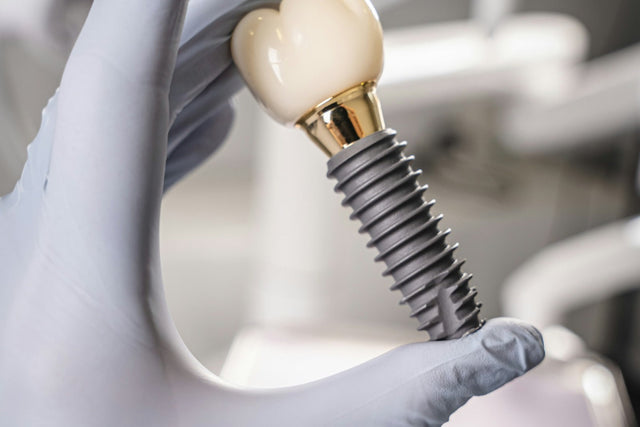
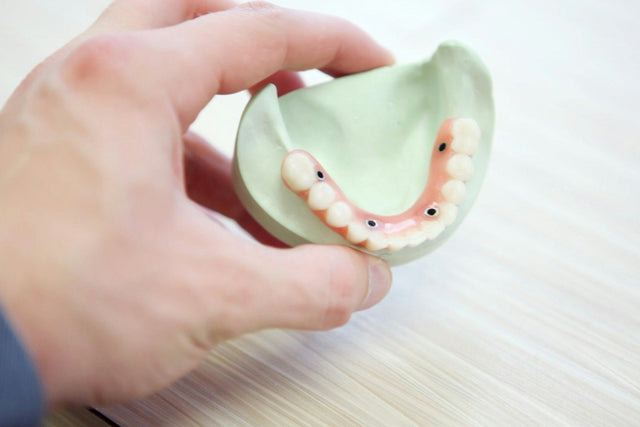
A patient comes in with a failing dentition or a loose denture and asks for "teeth in a day on four implants." The surgeon is ready to place four. Before you agree, the restorative questions are yours: is four enough in this arch, where should the distal implants go, how long can the cantilever be, and would the patient be better served by six implants or by a removable prosthesis?
There are now randomized trials of four against six implants, series followed for 15 to 25 years, and meta-analyses on tilted implants. Here is what they show for each arch, and what to plan with the lab.
Key Takeaways
- A 2018 meta-analysis of 93 studies found no significant difference in implant or prosthesis survival between fewer than five and five or more implants per arch, with a median follow-up of 8 years.
- In a 5-year randomized trial in the maxilla, implant survival was 100% with four implants and 99.3% with six, but technical complications were 16.6% against 0%.
- In the longest four-implant series, implant survival was 90% in the mandible at up to 25 years and 90.7% in the maxilla at up to 20 years.
- Tilted and axial implants failed at similar rates overall (1.63% against 1.81% of implants), but a maxilla-only analysis found a higher risk for tilted implants (risk ratio 1.70).
- In one 193-arch series, distal cantilevers averaged about 15.5 mm with cantilever-to-AP-spread ratios of 0.84 to 0.90.
Quick Answer
Four well-placed implants are enough for a fixed full arch in most mandibles and in many maxillae: survival with four matches five or six in meta-analyses and randomized trials. Consider five or six in the maxilla, where four had more technical complications in a randomized trial, or when the distal implants cannot be spread far enough to keep the cantilever short. Expect more prosthetic maintenance with four. If the patient wants a removable option, the maxilla needs four implants splinted with a bar.
Where Did the Four-Implant Concept Come From?
Maló first described the protocol in 2003. All-on-4 is Nobel Biocare's name for it: two axial anterior implants and two posterior implants tilted distally, loaded immediately with a fixed full-arch provisional. Tilting moves the posterior platforms back. In one private-practice series, posterior implants were tilted parallel to the anterior wall of the maxillary sinus and angled distally above the mental foramen.
Are Four Implants Really Enough?
What the meta-analyses say
For the 6th ITI Consensus Conference, a systematic review compared fixed complete-arch prostheses on fewer than five implants with those on five or more. They included 93 studies, 9 of them randomized, with follow-up from 1 to 15 years. The most common counts were 4 in the maxilla and 3 or 4 in the mandible in the smaller group, and 6 in the maxilla and 5 in the mandible in the larger one. Implant and prosthesis survival did not differ significantly.
Reviews focused on the four-implant concept agree. A 2014 review of 13 papers and 4,804 implants reported 36-month survival of 99.0% for implants and 99.9% for prostheses, with 74% of failures in the first 12 months. A 2025 overview of eight systematic reviews found cumulative survival of 94.8% to 99.3% and no review showing four implants to be inferior, but rated most reviews at high risk of bias.
What a randomized trial adds
A multicenter trial randomized patients to maxillary fixed complete dentures on four or six implants. At 5 years, 47 patients with 233 implants were reported: implant survival was 100% with four and 99.3% with six, with no significant difference in bone levels. The difference was maintenance. Technical complications were 16.6% with four implants and 0% with six. Four cost less. Clinicians and patients preferred four esthetically and six functionally, especially for speaking at the earlier visits.
Technical complications with four implants against 0% with six, in a 5-year randomized trial of maxillary fixed full arches; implant survival was 100% and 99.3%.
| Study | Four implants | Five or six implants |
|---|---|---|
| Review of 93 studies, median 8 years | No significant difference in implant or prosthesis survival | |
| Randomized trial, maxilla, 5 years | 100% implant survival; 16.6% technical complications; lower cost | 99.3% implant survival; 0% technical complications |
| Review of studies, up to 20 years | Prosthesis survival 85.0% to 100%; implant survival 89.7% to 97.9% | Prosthesis survival 88.2% to 100%; implant survival 98.9% to 99.0% |
Upper vs. Lower: Does the Arch Change the Answer?
The mandible
The lower arch has the longest record. In 245 patients with 980 immediately loaded implants, implant-related success was 94.8% and prosthesis survival 99.2% with up to 10 years of follow-up. In a larger series of 471 patients followed for 10 to 18 years, prosthetic survival was 98.8% and implant survival 93%. At 20 to 25 years, implant and prosthesis survival were 90% and 92%, and 70.7% of patients had at least one mechanical complication.
The maxilla
Upper-arch results are close. In 1,072 patients followed for 5 to 13 years, prosthetic success was 99.2% and implant survival 94.7%. Mechanical complications hit 58.8% of the provisional prostheses and 7.3% of the definitive ones. At 15 to 20 years in 740 patients, implant survival was 90.7%, prosthetic success 98.1%, and 35.1% of patients had biological complications, with smoking a major risk indicator.

| Patients on four implants | Arch | Follow-up | Implants | Prostheses |
|---|---|---|---|---|
| 245 patients | Mandible | Up to 10 years | 94.8% success | 99.2% survival |
| 471 patients | Mandible | 10 to 18 years | 93% survival | 98.8% survival |
| 181 patients | Mandible | 20 to 25 years | 90% survival | 92% survival |
| 1,072 patients | Maxilla | 5 to 13 years | 94.7% survival | 99.2% success |
| 740 patients | Maxilla | 15 to 20 years | 90.7% survival | 98.1% success |
Tilted implants in the maxilla
A meta-analysis of 44 publications found 1.63% of 5,029 tilted implants and 1.81% of 5,732 axial implants failed, with no significant difference overall. When only maxillary studies were pooled, tilted implants carried a higher failure risk (risk ratio 1.70). A 2018 systematic review for the ITI consensus found no differences in survival, bone loss or patient-reported outcomes, though only one study compared the two directly.

When Should You Plan Five or Six Implants?
The studies give no single cutoff. Consider more than four when:
- The maxilla is the arch. Tilted implants carried more risk there in the meta-analysis, and the randomized trial found more technical complications with four.
- The AP spread is short. If the distal implants cannot go far back, the cantilever must either be long or the arch must be short.
- Maintenance capacity is limited. Six implants had no technical complications in the trial; four had 16.6%.
- The patient smokes or has had peri-implant problems. Smoking, earlier biological complications and failure of a neighboring implant were risk indicators in the long series.
- Speech matters early. Patients in the trial rated six implants better for speaking at the earlier follow-ups.
How Long Can the Cantilever Be?
The classic approach limits the distal cantilever to a multiple of the anterior-posterior (AP) spread between the implants. A private-practice series of 193 arches gives real numbers for four implants. Average AP spread was 18.4 mm in the maxilla and 17.3 mm in the mandible. Distal cantilevers on the definitive prostheses averaged 15.4 to 15.6 mm. Cantilever-to-spread ratios were 0.84 to 0.90, under 1, and only 1 of 193 definitive prostheses had a denture base fracture.

A 2020 JADA review cautions that the relationship between AP spread and cantilever length is not linear and that AP-spread formulas have not been validated prospectively. Arch, implant number and distribution, material and framework design all matter. Use the ratio as a check, not a guarantee. For materials and the space each needs, see Full-Arch Implant Prosthesis: Zirconia vs. PMMA vs. Metal-Acrylic.
Fixed or Removable on Four Implants?
Four implants can also carry an overdenture, but the arches differ. A systematic review called the two-implant overdenture the first choice for the edentulous mandible. In the maxilla, it found implant survival of 97.0% per year with four or fewer implants splinted by a bar, 98.1% with six or more on a bar, and 88.9% with four or fewer unsplinted implants. An earlier review ranked six implants with a bar first, four with a bar second and four or fewer on ball attachments last.
| Option | Mandible | Maxilla |
|---|---|---|
| Fixed full arch on four | Longest follow-up; 93% implant survival at 10 to 18 years | Works; more technical complications than on six |
| Fixed full arch on five or six | Similar survival to four | Fewer technical complications in the randomized trial |
| Overdenture | Two implants are the first choice | Four or more, splinted with a bar |
Removable options are covered in Implant Overdentures: Two Implants, Locator-Type Attachments or a Bar?
What Does the Lab Need for a Four-Implant Case?
- Verified implant positions. A verification jig tried in the mouth, or photogrammetry.
- Multi-unit details. Implant system and platform, abutment brand, angulation and collar height for each site. See Implant Abutments Explained.
- The approved provisional. Scanned in occlusion and out of the mouth: it records vertical dimension, lip support and phonetics.
- Photos. At rest, full smile and retracted, with the midline marked.
- Opposing arch. A scan and what it is made of.
- Maintenance plan. Long series counted mechanical complications in most patients; see why implant screws loosen.
For scanning the multi-unit level, see How to Scan Implants.

Full-Arch Implant Cases at Elegant Dental Laboratory
- We work with all implant systems and most multi-unit abutment systems, with design libraries for all major systems. Every full-arch case gets a try-in prototype before the final; we use a verification jig and accept photogrammetry files.
- Full arches in zirconia, PMMA, PFM, e.max or hybrid designs, in as little as 4 days, usually a little longer than 5 business days. See implant restorations.
- Overdentures on LOCATOR, Novaloc, Equator or ball attachments, and bars on four or more implants.
- Every case is made in house by more than 35 technicians at our 7,000 sq. ft. facility at 2308 McDonald Ave, Brooklyn, with no outsourcing.
- Up to a 7-year warranty on final restorations and up to 20 years on screw-retained implant abutments (policies and warranties).
- Submit a digital case or send a case. Our own drivers pick up free every business day in the five NYC boroughs, Long Island and 13 northern New Jersey counties, and UPS labels work anywhere. New to us? Get started or call 877-335-5221.
FAQ
Is four implants enough for a full upper arch?
Often, yes. In a 5-year randomized trial, four maxillary implants had 100% survival against 99.3% with six, but 16.6% technical complications against none.
Do four implants last as long in the upper jaw as in the lower?
Long series report similar implant survival in both arches, about 90% at up to 20 to 25 years. Tilted implants carried more risk in maxilla-only data.
Are tilted implants weaker than straight ones?
Overall failure rates were similar in a meta-analysis (1.63% against 1.81%), but maxilla-only data showed a higher risk for tilted implants.
How long can the distal cantilever be?
No validated formula exists. In one 193-arch series, cantilevers averaged about 15.5 mm with ratios to the AP spread under 1.
Can four implants hold a removable denture instead?
Yes. In the maxilla, four or more implants splinted with a bar did much better than unsplinted implants. In the mandible, two implants are usually enough.
Why plan six if survival is the same?
Fewer technical complications, more support if an implant fails, and better early speech ratings in the randomized trial.
Sources (16)
- Daudt Polido W, et al. Number of implants placed for complete-arch fixed prostheses: A systematic review and meta-analysis. Clin Oral Implants Res. 2018;29 Suppl 16:154-183. doi:10.1111/clr.13312
- Toia M, et al. Fixed Full-Arch Maxillary Prostheses Supported by Four Versus Six Implants: 5-Year Results of a Multicenter Randomized Clinical Trial. Clin Oral Implants Res. 2025;36(3):298-313. doi:10.1111/clr.14383
- Huber BR, et al. All-on-Four Rehabilitation: A Systematic Review of Clinical Management, Workflow and Complications. Dent J (Basel). 2026;14(9):541. doi:10.3390/dj14090541
- Figueiredo CE, et al. Rehabilitation of edentulous jaws using the "All-on-Four" treatment concept: an overview of systematic reviews. Oral Maxillofac Surg. 2025;30(1):6. doi:10.1007/s10006-025-01492-7
- Patzelt SB, et al. The all-on-four treatment concept: a systematic review. Clin Implant Dent Relat Res. 2014;16(6):836-855. doi:10.1111/cid.12068
- Malo P, et al. A longitudinal study of the survival of All-on-4 implants in the mandible with up to 10 years of follow-up. J Am Dent Assoc. 2011;142(3):310-320. doi:10.14219/jada.archive.2011.0170
- Maló P, et al. The All-on-4 treatment concept for the rehabilitation of the completely edentulous mandible: A longitudinal study with 10 to 18 years of follow-up. Clin Implant Dent Relat Res. 2019;21(4):565-577. doi:10.1111/cid.12769
- de Araújo Nobre M, et al. Immediate full-arch mandibular rehabilitation supported by four implants: A retrospective study with 20 to 25 years of follow-up. J Dent. 2026;165:106286. doi:10.1016/j.jdent.2025.106286
- Maló P, et al. The All-on-4 concept for full-arch rehabilitation of the edentulous maxillae: A longitudinal study with 5-13 years of follow-up. Clin Implant Dent Relat Res. 2019;21(4):538-549. doi:10.1111/cid.12771
- de Araújo Nobre M, et al. Immediate Full-Arch Maxillary Rehabilitation Supported by Four Implants: A Retrospective Study with 15 to 20 Years of Follow-Up. J Clin Med. 2026;15(2):446. doi:10.3390/jcm15020446
- Chrcanovic BR, Albrektsson T, Wennerberg A. Tilted versus axially placed dental implants: a meta-analysis. J Dent. 2015;43(2):149-170. doi:10.1016/j.jdent.2014.09.002
- Lin WS, Eckert SE. Clinical performance of intentionally tilted implants versus axially positioned implants: A systematic review. Clin Oral Implants Res. 2018;29 Suppl 16:78-105. doi:10.1111/clr.13294
- Drago C. Ratios of Cantilever Lengths and Anterior-Posterior Spreads of Definitive Hybrid Full-Arch, Screw-Retained Prostheses: Results of a Clinical Study. J Prosthodont. 2018;27(5):402-408. doi:10.1111/jopr.12519
- Walter L, Greenstein G. Utility of measuring anterior-posterior spread to determine distal cantilever length off a fixed implant-supported full-arch prosthesis: A review of the literature. J Am Dent Assoc. 2020;151(10):790-795. doi:10.1016/j.adaj.2020.06.016
- Raghoebar GM, et al. A systematic review of implant-supported overdentures in the edentulous maxilla, compared to the mandible: how many implants? Eur J Oral Implantol. 2014;7 Suppl 2:S191-S201. PubMed
- Slot W, et al. A systematic review of implant-supported maxillary overdentures after a mean observation period of at least 1 year. J Clin Periodontol. 2010;37(1):98-110. doi:10.1111/j.1600-051X.2009.01493.x
Clinical figures come from published studies; the number and position of implants is a surgical and restorative decision for the treating team.