An impression leaves the operatory coated in saliva, sometimes blood, and then spends a day in a box. Disinfect it the wrong way and it swells or loses surface detail. Skip the step and the lab has to treat it as contaminated. Either way, the restoration fits worse than the prep you cut.
This is the routine an assistant can follow: what CDC and OSHA expect, which disinfectant and method suits each material, how long each stays accurate, how to pack it, and what the carrier rules actually say.
Key Takeaways
- CDC's 2003 dental guideline calls for cleaning, disinfecting with a tuberculocidal hospital disinfectant and rinsing every impression, bite and appliance before it goes to the lab, plus a note of the product and contact time.
- In a 2023 review of 50 studies, 10 minutes of 0.5 to 1% sodium hypochlorite or 2% glutaraldehyde inactivated oral flora, and disinfection within 30 minutes did not change alginate or polyether dimensions.
- Dentsply allows at most 24 hours before pouring its conventional Jeltrate alginate; Zhermack allows up to 5 days for its extended-pour Hydrogum 5.
- Dentsply's Aquasil Ultra+ PVS and 3M's Impregum polyether can be poured from 30 minutes up to 14 days.
- 3M warns that temperatures above 140 °F (60 °C) damage polyether impressions.
- DOT's infectious-substance rules exclude materials treated by chemical disinfection so they are no longer infectious (49 CFR 173.134).
Quick Answer
Rinse the impression clean, then disinfect it with an EPA-registered hospital disinfectant that carries a tuberculocidal claim, for the label's contact time and by the method the impression maker allows. Rinse again, write the product and time on the Rx, and pack it so nothing presses on it. Conventional alginate must be poured within hours (24 at most for Jeltrate); Aquasil Ultra+ PVS and Impregum polyether keep up to 14 days. Properly disinfected, impressions fall outside DOT's infectious-substance rules.
What Do CDC and OSHA Expect Before a Case Leaves the Office?
Treat it as contaminated until it is disinfected
OSHA's bloodborne pathogens standard lists saliva in dental procedures as "other potentially infectious material." CDC's Guidelines for Infection Control in Dental Health-Care Settings, 2003, which its 2016 summary builds on and the ADA urges dentists and labs to follow, calls impressions, occlusal rims and bite registrations potential sources of cross-contamination. Keep PPE on until disinfection is complete.
Clean, disinfect, rinse, right away
CDC's recommendation: before any prosthesis or prosthodontic material is handled in a lab, clean it, disinfect it with an EPA-registered hospital disinfectant with at least intermediate-level (tuberculocidal) activity, and rinse it, as soon as possible after removal, before blood and debris dry. EPA says to follow the label's tuberculosis directions, including the contact time. CDC also tells offices to check material stability with the manufacturer; the details below come from those instructions.
Tell the lab what you did
CDC asks offices to state the disinfectant and its duration when a case goes off-site. Coordination keeps materials from being distorted by overexposure and avoids disinfecting the same case twice.
Which Disinfectant and Method Suit Each Material?
Two rules cover most of it: use a disinfectant the impression maker allows, and stop at the label's contact time. A 2023 systematic review of 50 studies found that 10 minutes of 0.5 to 1% sodium hypochlorite or 2% glutaraldehyde inactivated oral flora and common pathogens, and that disinfection within 30 minutes did not alter the dimensional stability of alginate or polyether. For addition silicone (PVS), disinfection reduced wettability but not the other surface properties tested.
| Material (example product) | Method the maker gives | Contact time | When to pour |
|---|---|---|---|
| Conventional alginate (Dentsply Jeltrate) | Immersion in an alginate-specific disinfectant, preferably water-based quaternary ammonium | Disinfectant's label | Within 1 minute after disinfection, or up to 24 hours in a wet towel in a sealed bag |
| Extended-pour alginate (Zhermack Hydrogum 5) | Immersion (quaternary ammonium) or spray inside a closed bag (alcohol-based) | Disinfectant's label | Immediately, or within 5 days of impression-taking in an airtight polyethylene bag |
| PVS (Dentsply Aquasil Ultra+) | Immersion; intermediate-level disinfection is appropriate for lab handling | Validated: 30 minutes at 20 °C in 7.5% hydrogen peroxide; otherwise the disinfectant's label | 30 minutes after disinfection, up to 14 days |
| Polyether (3M Impregum) | Any water-based disinfectant indicated for impressions; 3M recommends glutaraldehyde | Disinfectant's label (no dimensional change within 30 minutes in the 2023 review) | 30 minutes to 14 days after taking the impression; keep dry |
| PVS bite registration (Dentsply Regisil Rigid) | Immersion; intermediate-level disinfection is appropriate for lab handling | Validated: 30 minutes at 20 °C in 7.5% hydrogen peroxide | Immediately after disinfection or up to 14 days |
Alginate: an alginate-specific product, briefly
Dentsply and Zhermack both say to start cleaning within 5 minutes of removal and to use a disinfectant made for alginate, and both warn that an unsuitable disinfectant can compromise the impression. Spray versus immersion is less settled than many offices assume: the 2023 review favored spraying with 0.5% sodium hypochlorite for 10 minutes, yet a lab study of 243 alginate impressions found that spraying with 5.25% sodium hypochlorite worsened cast surface detail, while immersed extended-pour alginates kept better detail after 120 hours. Follow your alginate's method, spray only inside a closed bag, and never store alginate under water.
PVS and bite registrations: immersion is fine
Dentsply's current Aquasil Ultra+ and Regisil Rigid guides say to start within 1 hour of use, rinse for at least 30 seconds, immerse fully, then rinse for at least 30 seconds again. PVS tolerates even high-level immersion in hydrogen peroxide, but intermediate-level disinfection is appropriate for laboratory handling. Dentsply does not recommend autoclaving the impression.
Polyether: soak, rinse, then dry
3M allows any water-based disinfectant indicated for impression materials. After disinfection, rinse well, blow dry and keep the impression dry when it goes to the lab.
Dentures, rims and appliances from try-in
CDC's list also covers occlusal rims, temporary prostheses, orthodontic appliances and dentures: clean, disinfect and rinse before the lab handles them. Going the other way, CDC says a lab that disinfects returning work should document it and use a tamper-evident container; without that documentation, final disinfection falls to the office.
How Long Does Each Impression Stay Accurate?
The longest Dentsply allows before pouring its conventional Jeltrate alginate, even wrapped in a wet towel in a sealed bag. Its Aquasil Ultra+ PVS allows up to 14 days (manufacturer instructions, 2025).
The pour window decides how a case can travel. A systematic review of 18 lab studies found traditional alginates generally stable when poured immediately, with stability decreasing over time, while extended-pour materials appeared to allow a delay. With a 24-hour ceiling, a conventional alginate leaves no room for a missed pickup: pour it in the office and send the stone model, or use an extended-pour alginate whose maker allows days.
PVS and polyether travel well. Both need at least 30 minutes before pouring and allow up to 14 days, so an overnight trip is fine if the impression stays cool and nothing presses on it.
How Should You Pack Impressions So They Do Not Distort?

- Alginate: remove excess water, then wrap in a wet towel in a sealed bag (Jeltrate) or seal in an airtight polyethylene bag (Hydrogum 5). Never ship it submerged.
- Polyether: dry it first. 3M says not to store it in a sealed plastic bag while still moist, or together with an alginate impression, and to keep it out of direct sunlight.
- PVS and bite registrations: Dentsply says to keep them out of direct sunlight and, if shipping, to use packaging that prevents distortion.
- Heat: keep every impression away from heat; 3M says temperatures above 140 °F damage polyether.
Are Disinfected Impressions Regulated for Shipping?
CDC states that clinical materials that are not decontaminated are subject to OSHA and U.S. Department of Transportation rules for shipping infectious materials, and OSHA requires warning labels on containers used to ship blood or other potentially infectious materials.
Disinfection changes that. DOT's rule, 49 CFR 173.134, says materials treated by chemical disinfection so they no longer meet the definition of an infectious substance are not subject to its Division 6.2 requirements. UPS's biological substances guidance refers domestic shippers to that same section. USPS Publication 52 (August 2026) treats a contaminated "used health care product" as an infectious-substance category only when it is not decontaminated or disinfected before transport. For air and international shipments, WHO's 2025 to 2026 guidance, which covers the UN, ICAO and IATA rules, says materials whose biological agents were inactivated or neutralized through decontamination are not considered infectious substances.
None of these documents names dental impressions specifically. The safe reading: disinfect properly, document it, never ship visible blood or debris, and if an item cannot be disinfected, call the lab before it goes in a box.

What Does CDC Ask the Lab to Do on Receipt?
CDC recommends that labs keep a separate receiving and disinfecting area. If no information about prior disinfection arrives, staff should clean and disinfect the case before handling it, and repeat if blood or debris turns up during work. Your note tells the lab whether that second round is needed.
When Does a Digital Scan Avoid the Problem?
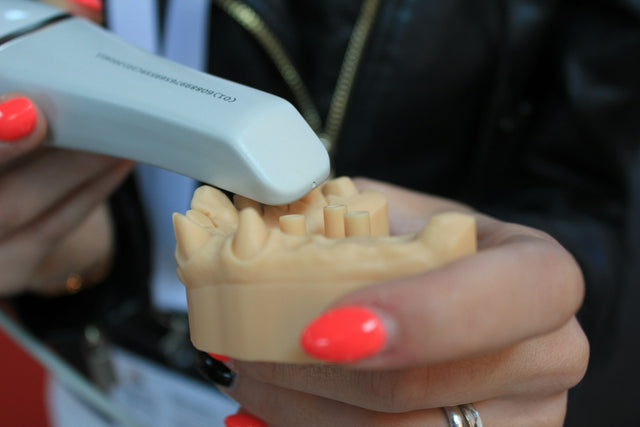
An intraoral scan has no disinfectant compatibility question, no pour window and nothing to distort in a hot truck or lose in transit. For when a scan is the better choice and when a conventional impression still wins, see Digital vs. Conventional Impressions.
Checklist
- Disinfect: rinse, then a tuberculocidal hospital disinfectant the impression maker allows, for the label's time.
- Finish: rinse again; dry polyether and PVS; keep alginate damp and sealed.
- Document: product, time, date and initials on the Rx or bag.
- Pack: rigid box, nothing touching the impression, no heat or sun.
- Time it: stay inside the maker's pour window.
Sending Impressions to Elegant Dental Laboratory
- Every case is made in house in Brooklyn by more than 35 technicians, with no outsourcing.
- We pour and scan impressions in house and disinfect every case with Cavicide when it arrives and again before it leaves. Our drivers can pick up unpoured alginate; for UPS shipping, send poured models. An impression and a scan can come in the same case.
- In New York City and northern New Jersey, our own drivers pick up and deliver free every business day during lab hours, in all five New York City boroughs and 13 northern New Jersey counties.
- Anywhere else, print a prepaid UPS shipping label; more on conventional cases at Send a Case.
- Skipping the impression? We accept STL and PLY files from all major intraoral scanners, with direct connections for iTero, 3Shape TRIOS, Dentsply Sirona, Medit, Carestream, Planmeca, DEXIS, Alliedstar, Straumann, Shining 3D, ORI and Panda, and review every scan before production (submit a digital case). Questions: 877-335-5221.
FAQ
Should I spray or soak an alginate impression?
Follow the alginate maker: Dentsply's current Jeltrate guide specifies immersion; Zhermack allows either, spraying inside a closed bag.
How long can a PVS impression wait before it is poured?
Dentsply allows pouring Aquasil Ultra+ from 30 minutes after disinfection up to 14 days, kept out of direct sunlight.
Does a disinfected impression need a biohazard label?
CDC's framework ties OSHA and DOT shipping rules to materials that are not decontaminated. Disinfect, document it on the Rx, and call the lab before shipping anything you could not disinfect.
Can I ship impressions by UPS or USPS?
Yes, once properly disinfected. DOT excludes chemically disinfected materials that are no longer infectious from its infectious-substance rules, and UPS points domestic shippers to that rule.
Will the lab disinfect the case again?
CDC tells labs to disinfect any case that arrives without disinfection information. A clear note helps avoid a second soak.
Do dentures and appliances need disinfection before going back to the lab?
Yes. CDC lists dentures, occlusal rims and orthodontic appliances alongside impressions.
Sources (21)
- Centers for Disease Control and Prevention. Guidelines for Infection Control in Dental Health-Care Settings, 2003. MMWR Recomm Rep. 2003;52(RR-17). Dental Laboratory, pp. 33 to 34; Recommendations, section I. PDF
- Centers for Disease Control and Prevention. Summary of Infection Prevention Practices in Dental Settings: Basic Expectations for Safe Care. October 2016. PDF
- American Dental Association. Infection Control and Sterilization (Oral Health Topics), updated October 5, 2022. ada.org
- Occupational Safety and Health Administration. Bloodborne Pathogens, 29 CFR 1910.1030 (definitions; (g)(1)(i)(A)). osha.gov
- U.S. Environmental Protection Agency. EPA's Registered Antimicrobial Products Effective Against Mycobacterium tuberculosis (List B). epa.gov
- Qiu Y, et al. Disinfection efficacy of sodium hypochlorite and glutaraldehyde and their effects on the dimensional stability and surface properties of dental impressions: a systematic review. PeerJ. 2023;11:e14868. doi:10.7717/peerj.14868
- Nassar U, Aziz T, Flores-Mir C. Dimensional stability of irreversible hydrocolloid impression materials as a function of pouring time: a systematic review. J Prosthet Dent. 2011;106(2):126-133. doi:10.1016/S0022-3913(11)60108-X
- Sharif RA, et al. The accuracy of gypsum casts obtained from the disinfected extended-pour alginate impressions through prolonged storage times. BMC Oral Health. 2021;21(1):296. doi:10.1186/s12903-021-01649-2
- Demajo JK, et al. Effectiveness of Disinfectants on Antimicrobial and Physical Properties of Dental Impression Materials. Int J Prosthodont. 2016;29(1):63-67. doi:10.11607/ijp.4358
- Dentsply Sirona. Jeltrate Alginate Impression Material, Technique Guide: Product Info, TG204WEB (R 09/05/25). PDF
- Dentsply Sirona. Jeltrate Alginate Impression Materials, Technique Guide: Illustrated, 008110TG, Rev. 2026/05. PDF
- Zhermack (Dentsply Sirona). Hydrogum 5, Hydrocolor 5, Pinkalgin 5 Instructions for Use, U500083, last update 2025-04. PDF
- Dentsply Sirona. Aquasil Ultra+ Smart Wetting Impression Material, Technique Guide: Product Info, TG141WEB (R 04/28/25). PDF
- Dentsply Sirona. Regisil Rigid Vinyl Polysiloxane Bite Registration Material, Technique Guide: Product Info, TG159WEB (R 05/23/25). PDF
- 3M. Impregum Polyether Impression Material: Lab handling guidelines for polyether impressions, 2021. PDF
- 3M. Impregum Super Quick Polyether Impression Material: Frequently Asked Questions, 2018. PDF
- McLaren C, Null J, Quinn J. Heat stress from enclosed vehicles: moderate ambient temperatures cause significant temperature rise in enclosed vehicles. Pediatrics. 2005;116(1):e109-e112. doi:10.1542/peds.2004-2368
- U.S. Department of Transportation. 49 CFR 173.134, Class 6, Division 6.2: Definitions and exceptions (eCFR, up to date as of September 29, 2026). ecfr.gov
- United States Postal Service. Publication 52, Hazardous, Restricted, and Perishable Mail (August 2026), section 346. pe.usps.com
- UPS. Shipping Biological Substances FAQs. ups.com
- World Health Organization. Guidance on regulations for the transport of infectious substances 2025-2026, applicable as from 1 October 2025. who.int
Reviewed by Gary Fingerman, founder and CEO of Elegant Dental Laboratory, Brooklyn, New York (founded 2007). Last reviewed: October 1, 2026. Contact times and pour windows are from published research or manufacturer instructions; always follow the current instructions for use of your impression material and your disinfectant.