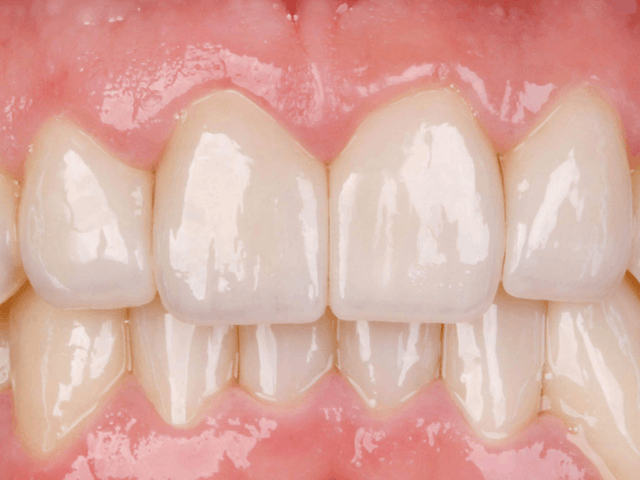
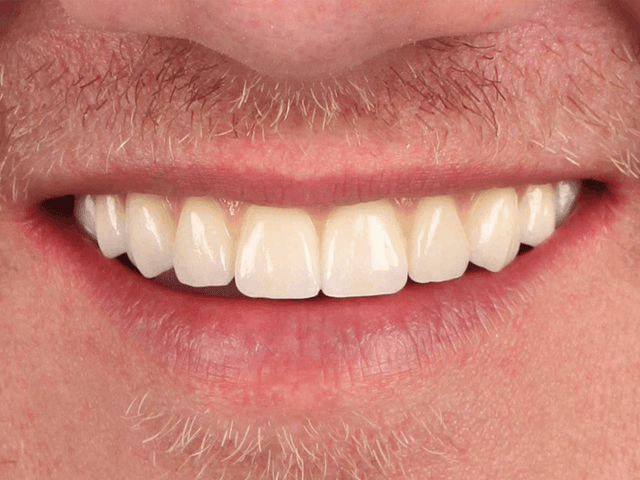
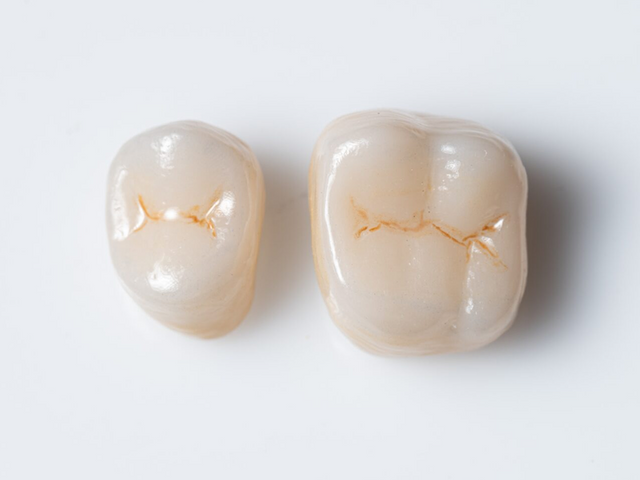
A patient looks at the bitewing after a new crown and asks why the "metal-free" crown they paid for shows up bright white, exactly like the old metal one next to it. Or a new assistant asks whether zirconia and zirconium are the same thing. Both are fair questions.
Here are the plain answers, each backed by a source: what zirconia is, why it looks like metal on an X-ray, and what that means for allergies, billing and the Rx.
Key Takeaways
- Zirconium is a metal: element 40, hard and silvery.
- Zirconia is zirconium dioxide (ZrO2), an oxide ceramic. It contains zirconium the way table salt contains sodium: bound, not as metal.
- In a lab study of 128 specimens, zirconia was as radiopaque as metals, while pressed e.max was no more radiopaque than dentin.
- In 14 patients with dental alloy allergy, zirconia bridges caused no reactions over 3 years.
- For billing, zirconia crowns are ceramic crowns: Medi-Cal's February 2026 bulletin places them under D2740.
Quick Answer
No, zirconia is not a metal. It is zirconium dioxide (ZrO2), an oxide ceramic made when the metal zirconium is combined with oxygen. A zirconia crown contains no metal alloy, so it counts as a metal-free, all-ceramic restoration. It looks like metal on radiographs only because it is dense and made of heavy zirconium atoms that block X-rays, and early dental zirconia was even used as a "white metal."
The atomic number of zirconium (Royal Society of Chemistry). Heavy atoms stop X-rays well, which is why a zirconia crown shows up as bright as metal on a radiograph.
Zirconium vs. Zirconia: What Is the Difference?
Zirconium (Zr) is a chemical element. The Royal Society of Chemistry describes it as "a hard, silvery metal that is very resistant to corrosion." Zirconia is a compound: one zirconium atom bound to two oxygen atoms, ZrO2. A 2023 review in PeerJ calls it "a crystalline oxide of zirconium."
A metal bound to oxygen no longer behaves like a metal. Rust is iron oxide, not iron; sapphire is aluminum oxide, not aluminum. Zirconia is the same kind of material: a white ceramic with no free zirconium metal in it.
| Zirconium | Zirconia | |
|---|---|---|
| What it is | A chemical element, a metal | An oxide of zirconium, a ceramic |
| Formula | Zr | ZrO2 |
| Looks like | Hard, silvery metal | White or tooth-colored solid |
| Typical uses | Nuclear power: more than 90% of the metal | Crowns, bridges, abutments, knives, furnace linings |
| In a zirconia crown? | No, only bound inside the oxide | Yes, with a small amount of yttria |
Why Is Zirconia Called a Ceramic and Not a Metal?
A ceramic is an inorganic, nonmetallic solid, often a metal bound to oxygen and fired at high temperature. Zirconia fits exactly: it is milled and sintered, not cast like an alloy.
Pure zirconia changes its crystal form with temperature. The PeerJ review describes three forms, monoclinic, tetragonal and cubic: pure zirconia is monoclinic at room temperature, becomes tetragonal at about 1,170 °C, and changes volume by about 5% when it turns back. That volume change would crack a crown, so manufacturers add yttrium oxide, which keeps the strong tetragonal form stable at room temperature.
The amount of yttria gives the grades their names. 3Y-TZP has about 3 mol% yttria, and 4Y, 5Y and 6Y have more. More yttria means more translucency and less strength: the PeerJ review notes that the fracture toughness of 5Y-TZP is almost 50% lower than that of 3Y-TZP; our guide to types of zirconia covers the grades in detail.

Why Was Zirconia Called "White Metal"?
Because it took over jobs that only metal could do. Zhang and Lawn, in the Journal of Dental Research, call zirconias "the strongest of the dental ceramics." Partially stabilized zirconia has been promoted for dental use since the end of the 1990s for its strength and fracture resistance, which come from transformation toughening: at a crack, the stabilized crystals change form in a way that resists it.
That strength let zirconia replace the metal substructure under porcelain, and early 3Y-TZP was used in dentistry as a "white metal," according to the PeerJ review. The nickname stuck, and with it some of the confusion.
Why Does a Zirconia Crown Look Like Metal on an X-Ray?
Radiopacity depends on how dense a material is and how heavy its atoms are. The PeerJ review puts zirconia's radiopacity above that of aluminum and titanium and explains it by "its intrinsically high density and effective atoms." Zirconium is far heavier than the calcium and phosphorus of enamel, and one CBCT study groups zirconia with metal-ceramic crowns as "high atomic numbered crowns."
A study in the Journal of Prosthetic Dentistry measured 128 disc specimens of ceramics and metals. Zirconia had the highest radiopacity of all the ceramics tested, similar to metals and, like titanium alloy, nickel-chromium and 22-carat gold, significantly above enamel. Pressed e.max and several porcelains were no different from dentin. In a 2020 clinical comparison of 3-unit bridges in the molar area, zirconia showed "intense radiopacity" and weighed 5 g, against 2 g each for composite resin, PEEK and PEKK versions.
So a bright crown on a bitewing does not mean metal. The radiograph cannot tell zirconia from a cast crown; the chart and the lab invoice can.
Is Zirconia Safe for Patients With a Metal Allergy?
The evidence is reassuring, though small. In a study in the International Journal of Prosthodontics, 14 patients with patch-tested allergy to dental alloys had their PFM bridges replaced with zirconia-framework bridges. No hypersensitivity lesions appeared in the mouth or on the skin over 3 years of follow-up.
One caution: a zirconia crown on a titanium base or a metal post still puts metal in the mouth, so write the full design on the Rx when the patient's history matters.
How Is Zirconia Coded and Invoiced?
As a ceramic. Medi-Cal's February 2026 provider bulletin states that D2740, the porcelain/ceramic crown code, covers "zirconia crowns, lithium silicate, disilicate ceramic materials." Metal crown codes go by alloy class, which zirconia does not have. Our guide to CDT codes for lab work lists the common codes and the mismatches that cause denials.
Zirconia at Elegant Dental Laboratory
We mill zirconia in house in Brooklyn from our own Elegance Zirconia discs, in solid 3Y and 9-layer 5Y, with no outsourcing. We follow the brand or grade written on the Rx; when the Rx names none, posterior teeth get solid zirconia and anterior teeth zirconia with porcelain. We sandblast the inside of zirconia crowns before shipping, and the invoice names the material by brand, so the chart and the claim can match it. Turnaround is from 5 business days. See our zirconia restorations or get started with a first case.
FAQ
Is zirconia the same as zirconium?
No. Zirconium is a metal element; zirconia is zirconium dioxide, a ceramic. "Zirconium crown" is a common slip.
Is a zirconia crown metal-free?
Yes, it contains no metal alloy. On a titanium base or a metal post, the crown is metal-free but the assembly is not.
Why does zirconia look like metal on an X-ray?
It is dense and made of heavy zirconium atoms, which absorb X-rays strongly. In one study it was as radiopaque as metals.
Can patients with a metal allergy get zirconia crowns?
Usually yes. In a small study, 14 patients allergic to dental alloys had no reactions to zirconia bridges over 3 years.
Sources (9)
- Royal Society of Chemistry. Periodic Table: Zirconium (atomic number, appearance, discovery, uses, natural abundance). periodic-table.rsc.org
- Kongkiatkamon S, Rokaya D, Kengtanyakich S, Peampring C, Husein A. Current classification of zirconia in dentistry: an updated review. PeerJ. 2023;11:e15669. doi:10.7717/peerj.15669
- Zhang Y, Lawn BR. Novel Zirconia Materials in Dentistry. J Dent Res. 2018;97(2):140-147. doi:10.1177/0022034517737483
- Vagkopoulou T, Koutayas SO, Koidis P, Strub JR. Zirconia in dentistry: Part 1. Discovering the nature of an upcoming bioceramic. Eur J Esthet Dent. 2009;4(2):130-151. PubMed 19655651
- Pekkan G, Pekkan K, Hatipoglu MG, Tuna SH. Comparative radiopacity of ceramics and metals with human and bovine dental tissues. J Prosthet Dent. 2011;106(2):109-117. doi:10.1016/S0022-3913(11)60104-2
- Rauch A, Hahnel S, Günther E, Bidmon W, Schierz O. Tooth-Colored CAD/CAM Materials for Application in 3-Unit Fixed Dental Prostheses in the Molar Area: An Illustrated Clinical Comparison. Materials. 2020;13(24):5588. doi:10.3390/ma13245588
- Gökçen-Röhlig B, Saruhanoglu A, Cifter ED, Evlioglu G. Applicability of zirconia dental prostheses for metal allergy patients. Int J Prosthodont. 2010;23(6):562-565. PubMed 21209994
- Medi-Cal Dental. Provider Bulletin, February 2026, Volume 42, Number 05: CDT Code D2740 Benefit and Billing. dental.dhcs.ca.gov
- Bilgin MS, Aglarci OS, Erdem A. Posttreatment diagnosis of caries under fixed restorations: a pilot study. J Prosthet Dent. 2014;112(6):1364-1369. doi:10.1016/j.prosdent.2014.06.014
Reviewed by Gary Fingerman, founder and CEO of Elegant Dental Laboratory, Brooklyn, New York (founded 2007). Last reviewed: November 2, 2026.