In the early 1950s a Corning chemist named S. Donald Stookey put a plate of glass into a furnace set to 600 degrees Celsius. The furnace failed and ran up to 900. He expected a puddle. He found a milky white plate, and when it slipped from his tongs it bounced off the floor instead of shattering. In his words, it was "obviously much stronger than ordinary glass." That accident gave us glass-ceramics, the family your e.max crowns belong to.
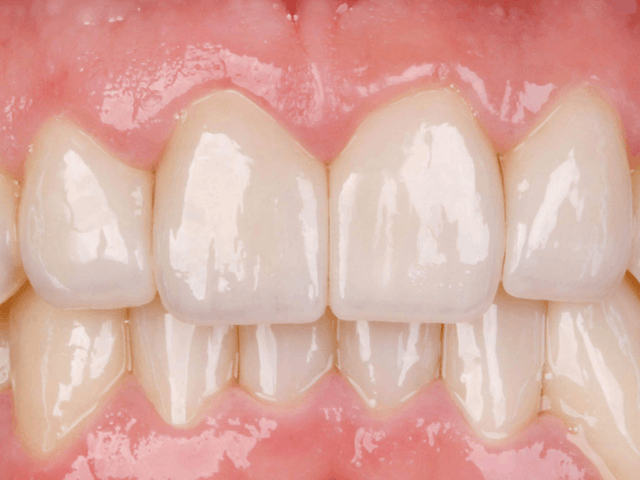
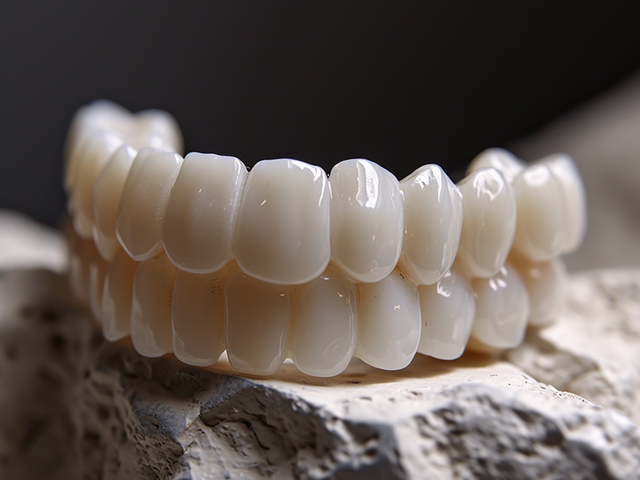
So is e.max glass? Not quite: IPS e.max is a lithium disilicate glass-ceramic, a glass that has been heated until most of it grows into tiny interlocking crystals, with a thin glass phase left between them. The glass is why it etches like porcelain. The crystals are why it is several times stronger.
Below is the sheet we wish every new associate had taped above the bonding station: what is inside each ceramic you prescribe, whether it etches, and for how long.

Where Does E.max Sit Among Dental Ceramics?
Dental materials scientists sort ceramics by one question: is there a glass phase or not? A 2015 classification in the International Journal of Prosthodontics splits them into glass-matrix ceramics, polycrystalline ceramics with no glass, and resin-matrix ceramics. E.max is in the first family. Zirconia is in the second.
| Material | What is inside | Glass phase? | Hydrofluoric acid etch | Typical work |
|---|---|---|---|---|
| Feldspathic porcelain | Mostly glass, few or no crystals | Yes, most of it | About 60 seconds | Layering, thin veneers |
| Fluorapatite layering ceramic (IPS e.max Ceram) | 19 to 23% fluorapatite crystals in glass | Yes | About 120 seconds | Layering over e.max or zirconia |
| Leucite glass-ceramic (IPS Empress) | About 45% leucite crystals in glass | Yes | About 60 seconds | Veneers, inlays, onlays, single crowns |
| Lithium disilicate (IPS e.max) | About 70% lithium disilicate crystals in glass | Yes, a thin one | About 20 seconds | Crowns, veneers, inlays, onlays |
| Zirconia | Zirconium oxide crystals only | No | Does not etch: air abrasion and an MDP primer instead | Crowns, bridges, full arch |
Etch times are the usual protocols for a hydrofluoric acid gel of about 4 to 5% as reported in a 2018 review of glass-ceramic etching; the crystal shares come from reviews and refer to the makers' materials named in the table. Always follow the instructions for the exact product in your hand.
What Is a Glass-Ceramic, in Plain Words?
Ordinary glass is a solid with no pattern: its atoms are frozen in place like a crowd, not lined up like soldiers. A crystal is the soldiers. A glass-ceramic starts life as a glass and is then heated on a schedule so that crystals first seed and then grow inside it. Stookey's real achievement was learning to control that seeding and growth on purpose.
E.max is mostly silica. Ivoclar's 2026 instructions for IPS e.max Press give the composition as 57 to 80% silicon dioxide and 11 to 19% lithium oxide by weight, plus smaller amounts of other oxides and pigments. The crystals that grow from that recipe are lithium disilicate: long, thin needles that pack together like a pile of matchsticks.
The milled version (see e.max Press vs. e.max CAD) shows the process in slow motion. An IPS e.max CAD block is sold in a soft "blue state" that holds about 40% lithium metasilicate, which mills easily at a flexural strength around 130 MPa. A firing at 840 to 850 degrees Celsius for 10 minutes turns it into about 70% lithium disilicate, and the blue block comes out tooth colored and far stronger.
Why Does E.max Etch Like Glass?
Because hydrofluoric acid attacks glass, not the lithium disilicate crystals. On e.max, the acid eats away the thin glass phase around the needles and leaves a rough, honeycomb surface of exposed crystals. Silane and resin cement lock into that surface, which is why e.max can be bonded to thin, minimally retentive preparations.
The amount of glass also explains the different etch times. Lithium disilicate has only a little glass between its crystals, so a short etch is enough: about 20 seconds with a gel such as IPS Ceramic Etching Gel, which the 2018 review describes as 4% hydrofluoric acid. Feldspathic and leucite ceramics usually get about 60 seconds, and fluorapatite layering ceramic about 120. Longer is not better: the same review reports that etching longer than 60 seconds raises the rate of cohesive failures inside the ceramic.

How Much Stronger Is It Than Ordinary Glass-Based Porcelain?
Typical biaxial flexural strength of IPS e.max Press in Ivoclar's 2026 instructions, against 90 MPa for its IPS e.max Ceram layering ceramic and 185 MPa for leucite-based IPS Empress CAD (manufacturer figures, ISO 6872).
Two things make the difference, according to a 2019 review in BMC Oral Health. The interlocked needles block cracks from running straight through the material, and the glass around the crystals shrinks onto them as it cools, putting them under compressive stress. A crack has to keep changing direction, and it runs out of energy.
The material has improved over time too. The first lithium disilicate on the market, IPS Empress 2 in the 1990s, held 65% crystals by volume with a reported strength of 350 MPa. A reformulated version with smaller, more even crystals was launched as IPS e.max Press in 2005, and the review reports 370 to 460 MPa for it.

A lab test of a polished bar is not a crown in a mouth, and brands test differently. What the chart shows is the order of things, which matches what we see on the bench: layering porcelain chips, e.max holds up as a full-contour crown, and zirconia is in another league for strength.
Then How Is E.max Different From Zirconia?
Zirconia has no glass at all. It is a polycrystalline oxide ceramic, crystals packed against crystals, so the 2019 review notes it is free of silica and cannot be conditioned with conventional acid etching. That is the whole reason the two materials are cemented differently: e.max is etched and silanated, zirconia is air abraded and primed with an MDP product, and on a retentive preparation it can go in with a conventional or resin-modified glass ionomer cement. For the step-by-step version, see how to cement zirconia and bond e.max.
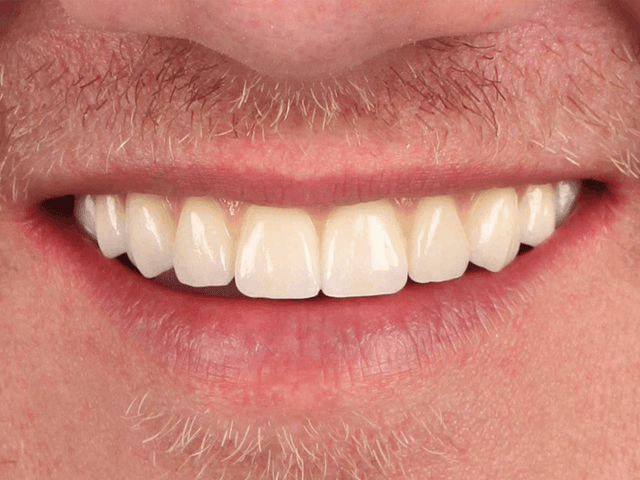
It is also why e.max looks the way it does. Light passes through the glass phase, which gives lithium disilicate the translucency that makes it a favorite for anterior teeth. Zirconia trades some of that for strength. If you are choosing between them for a case, our zirconia vs. e.max comparison goes tooth by tooth, and is zirconia a metal? covers the other material's identity question.

E.max at Our Bench
At Elegant Dental Laboratory in Brooklyn we press e.max only with IPS e.max Press: full-contour crowns, layered crowns, veneers from 0.3 mm, inlays, onlays and table tops, and e.max crowns on titanium bases. For dark preparations we use the high-opacity HO ingots, so the crystals and glass hide the stump instead of showing it.
Because the glass phase is what bonds, we etch the inside of every e.max crown before it ships. If you prefer to etch chairside right before cementation, ask for the crown unetched on the Rx and we will leave that step to you. Our turnaround is from 5 business days. See the IPS e.max options or send a case.

In Short
- E.max is a lithium disilicate glass-ceramic: mostly crystals, with a thin glass phase between them.
- The glass phase is why it etches with hydrofluoric acid, in about 20 seconds.
- The interlocking crystals are why it is several times stronger than glass-based layering porcelain.
- Zirconia has no glass, cannot be acid etched, and is cemented differently.
- Follow the instructions for the exact product: etch times differ by ceramic.
Sources (10)
- De Guire E. Retired Corning scientist S. Donald Stookey dies at 99. The American Ceramic Society, ACerS Spotlight. ceramics.org
- Gracis S, Thompson VP, Ferencz JL, Silva NR, Bonfante EA. A new classification system for all-ceramic and ceramic-like restorative materials. Int J Prosthodont. 2015;28(3):227-235. doi:10.11607/ijp.4244
- Zarone F, Di Mauro MI, Ausiello P, Ruggiero G, Sorrentino R. Current status on lithium disilicate and zirconia: a narrative review. BMC Oral Health. 2019;19(1):134. doi:10.1186/s12903-019-0838-x
- Bajraktarova-Valjakova E, Grozdanov A, Guguvcevski L, et al. Acid etching as surface treatment method for luting of glass-ceramic restorations, part 1: acids, application protocol and etching effectiveness. Open Access Maced J Med Sci. 2018;6(3):568-573. doi:10.3889/oamjms.2018.147
- Cuzic C, Rominu M, Pricop A, et al. Clinician's guide to material selection for all-ceramics in modern digital dentistry. Materials (Basel). 2025;18(10):2235. doi:10.3390/ma18102235
- Ivoclar. IPS e.max Press, instructions for use, Rev. 2, January 8, 2026. ivoclar.com
- Ivoclar. IPS e.max CAD, instructions for use, Rev. 5, February 11, 2026. ivoclar.com
- Ivoclar. IPS Empress CAD, instructions for use, Rev. 1, November 12, 2025. ivoclar.com
- Ivoclar. IPS e.max Ceram, instructions for use, Rev. 0, August 26, 2024. ivoclar.com
- Ivoclar. IPS e.max ZirCAD (laboratory), instructions for use, Rev. 3, February 11, 2026. ivoclar.com
Reviewed by Gary Fingerman, founder and CEO of Elegant Dental Laboratory, Brooklyn, New York (founded 2007). Last reviewed: November 9, 2026.